News·Korea Heritage Service
Gongsanseong Fortress, Gongju: what the Baekje palace dig has found, and what you can see
Summary
On 11 November 2026 the Korea Heritage Service published a summary of more than 40 years of digging at the Baekje royal palace site inside Gongsanseong Fortress in Gongju, capital of the Baekje kingdom from 475 to 538. The headline find is a monumental palace gate, first identified in 2019: a 10 m road flanked by two earthen towers about 9 to 11 m high. The fortress is open all year (KRW 3,000 for adults, 09:00 to 17:00 from November to February), but the excavation area itself has no announced public opening, so plan to see it from the fortress paths.
Article
In short
- On 11 November 2026 the Korea Heritage Service, with South Chungcheong Province, Gongju City and Kongju National University, published a combined account of the excavations at the Baekje palace site inside Gongsanseong Fortress in Gongju.
- The key structure is the palace gate with flanking towers, first identified in 2019 and the first of its kind found in Korea. A 10 m road runs between two towers, each about 40 m east to west, 23 m north to south and 9 to 11 m high.
- Inside the gate the digs found a large hall seven bays wide and three deep (32.3 m east to west), corridor buildings of roughly 26 to 34 m, and a square platform about 104 m by 87 m built by filling in a ravine.
- Gongsanseong is open all year (KRW 3,000 for adults; 09:00 to 17:00 from November to February). There is no announced public opening of the excavation area, so you see it from the fortress paths.
- The release and the city ticket page are in Korean only; no booking is needed for the fortress.
When Baekje lost its first capital near present-day Seoul in 475, the court moved south to Ungjin, today's Gongju, and stayed there until it moved again to Sabi (Buyeo) in 538. Where the king actually lived in those 64 years has been argued over for decades. Evidence gathered since 1980 points to the area around Ssangsujeong pavilion inside Gongsanseong Fortress, and on 11 November the Korea Heritage Service drew it together at Kongju National University and at the dig. Worth knowing first: this is a summary of past work, not a new discovery. Even the palace gate that drew the headlines was first identified in 2019.
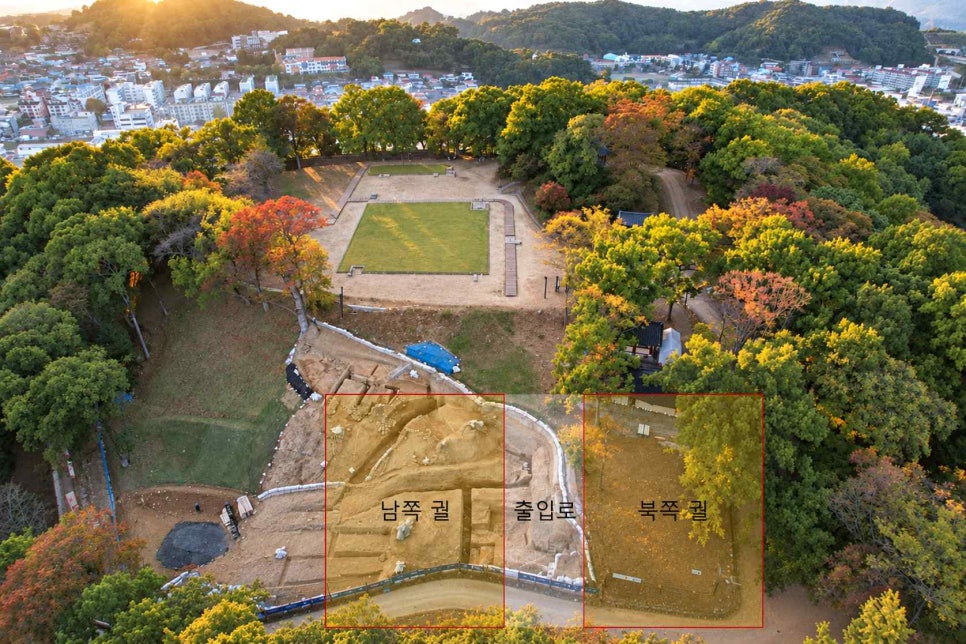
The Baekje palace site at Gongsanseong, with the southern tower, entrance road and northern tower marked (released 2026)
Photo: Korea Heritage Service · KOGL Type 1 · Original
How long has the palace site been under excavation?
Partial digs at Gongsanseong began in 1980. In 1985 and 1986 the area around Ssangsujeong yielded many Baekje roof-tile ends, the first strong hint of a palace. After the Baekje Historic Areas were inscribed as a UNESCO World Heritage Site in 2015, the Korea Heritage Service put the fortress under a long-term excavation master plan, and systematic research digging followed.
Excavating the Gongsanseong palace site
- 1980
- Partial excavation of Gongsanseong begins
- 1985 to 1986
- Many Baekje roof-tile ends found around Ssangsujeong; the area is identified as a likely palace site
- 2015
- World Heritage inscription; research digging under the heritage service's master plan
- 2019
- A monumental palace gate with towers is identified, the first in Korea
- 11 November 2026
- Combined findings on the palace layout published
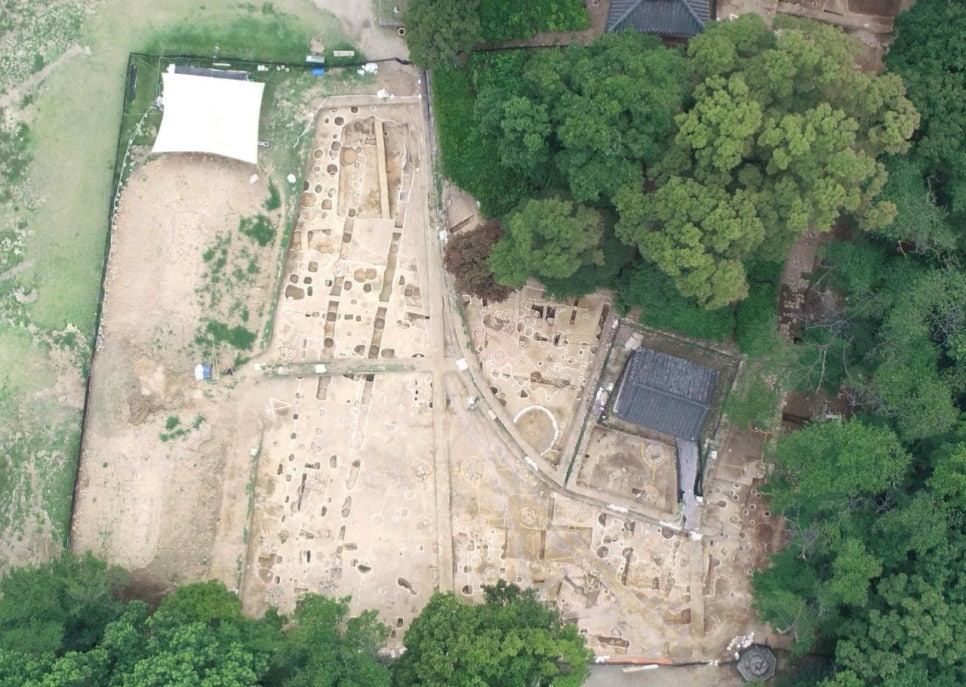
Baekje building remains exposed in the square by Ssangsujeong (released 2019)
Photo: Korea Heritage Service (then the Cultural Heritage Administration) · KOGL Type 1
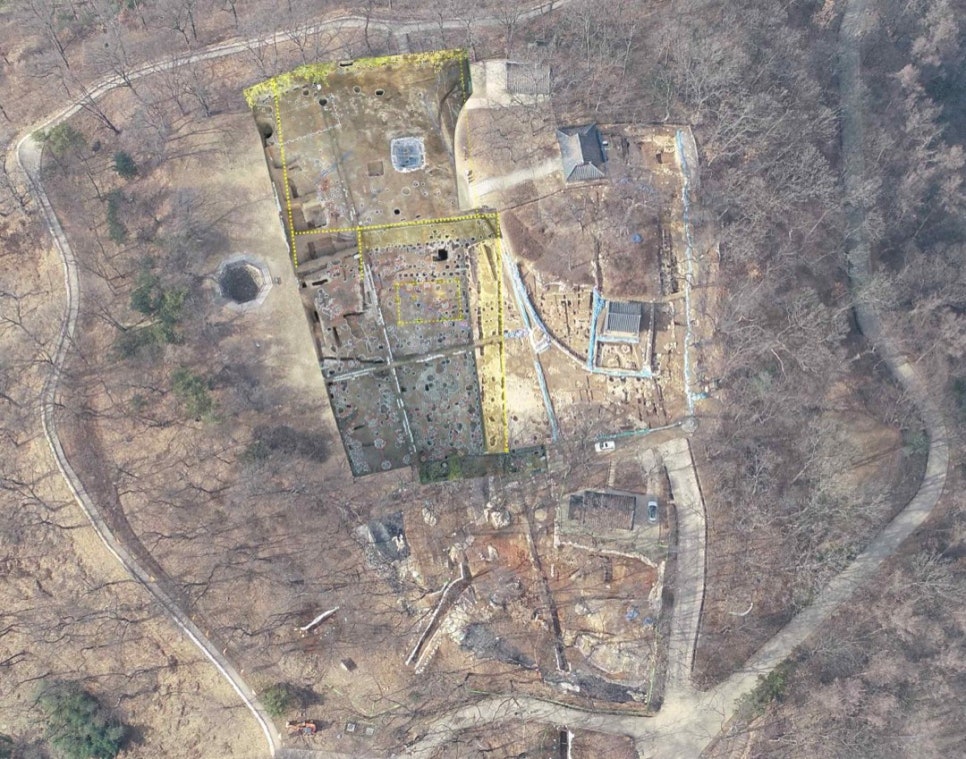
The presumed palace area and survey zones, outlined in yellow (released 2023)
Photo: Korea Heritage Service · KOGL Type 1
What is the palace gate, and how big is it?
A gate of this kind (munkwol, 문궐) combines a palace entrance with watchtowers on either side, built to show anyone arriving the rank of the place they were entering. At Gongsanseong a 10 m road runs through the middle, with a large earthen tower facing it from each side. The Korea Heritage Service reads it as the work of a dynasty steadying itself after the flight from the old capital, raising the palace's standing to match.
The Gongsanseong palace gate (Korea Heritage Service release, 11 November 2026)
- Central road
- 10 m wide
- Each tower
- About 40 m east to west, 23 m north to south, 9 to 11 m high
- Layout
- Two towers, symmetrical on a north to south axis
- First identified
- 2019, the first such gate found in Korea
The heritage service describes the gate as the core evidence that fixes the palace's location inside Ungjin's royal fortress, and calls its historical and academic value considerable.
What was found inside the palace?
Behind the gate the digs traced the buildings of the palace itself. At the centre stands a large hall facing south, enclosed by long corridor-style buildings that divided the compound by function and rank. The release stresses that the hall closely matches, in plan and size, the large halls excavated at Gwanbuk-ri in Buyeo and Wanggung-ri in Iksan: the palace architecture of all three Baekje capitals belongs to one lineage.
- Large hall: seven bays across and three deep, 32.3 m east to west and 14.6 m deep
- Corridor buildings: about 26 to 34 m long, dividing the compound east to west and north to south
- Also found: walls and a pond
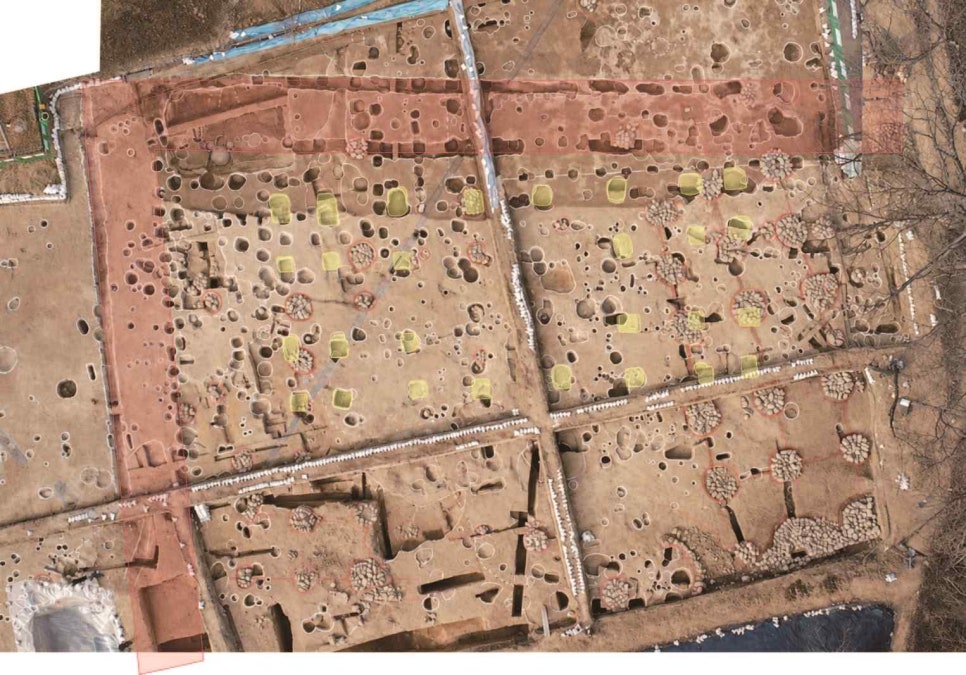
The corridor buildings and the large hall, shaded (released 2026)
Photo: Korea Heritage Service · KOGL Type 1
What does it mean that the palace was built on a filled-in ravine?
The flat ground at the centre of the palace site was once a ravine about 3 to 7 m deep. Baekje builders filled it with earth to make a square platform about 104 m north to south and 87 m east to west, and stepped the northern and western slopes with earthen terraces. Fitting a palace into the cramped hilltop of a fortress took large-scale civil engineering, which the heritage service takes as further evidence of the palace's status.
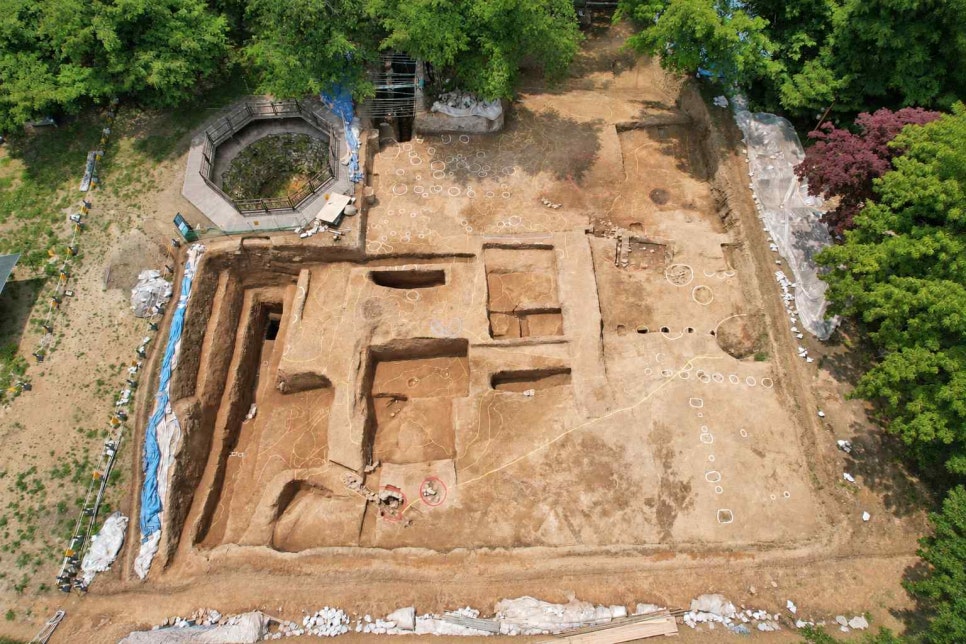
Layers of fill used to build up the palace platform (released 2026)
Photo: Korea Heritage Service · KOGL Type 1
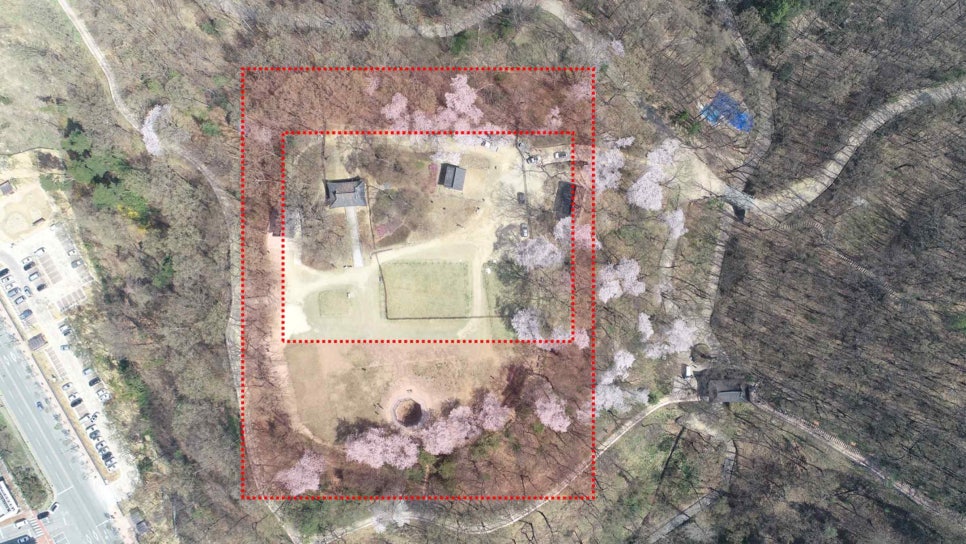
The 2023 survey zone around the presumed palace area, red dotted line (released 2023)
Photo: Korea Heritage Service · KOGL Type 1
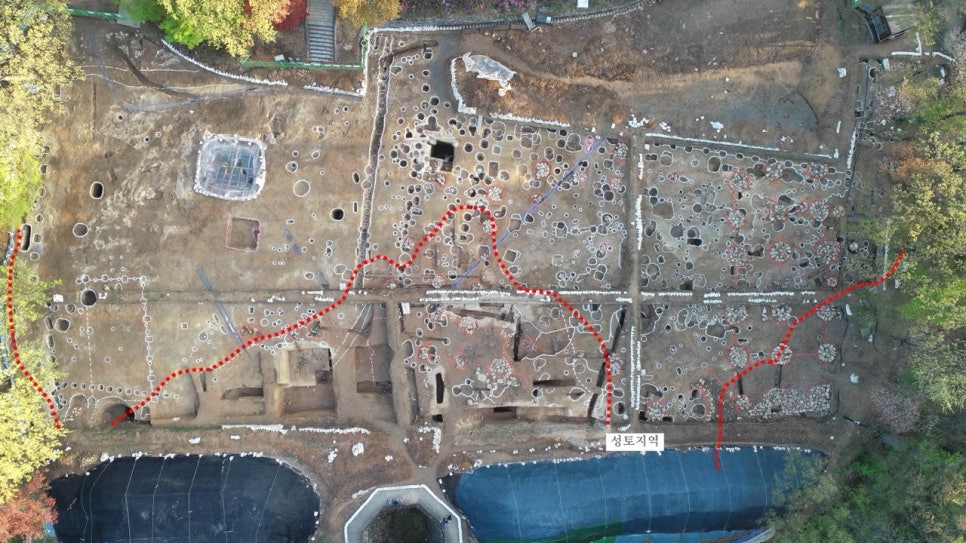
Extent of the built-up ground around the southern pond, red dotted line (released 2023)
Photo: Korea Heritage Service · KOGL Type 1
Why is it linked to Baekje 'becoming strong again'?
In 521 King Muryeong wrote to the Liang court in China that Baekje had become a strong state once more (gaengwi gangguk, 更爲强國). The heritage service argues that the monumental gate and the scale of the palace give that claim archaeological backing: a line in a diplomatic letter, supported by what lies in the ground.
What are the lacquered armour and horse armour reproductions?
The briefing also unveiled reproductions of the lacquered armour and horse armour excavated at Gongsanseong in 2011. They are the result of conservation, analysis and roughly a decade of reconstruction work, and recover the lacquering and armour-making techniques the originals preserve. The release does not say where the reproductions will be on permanent display.
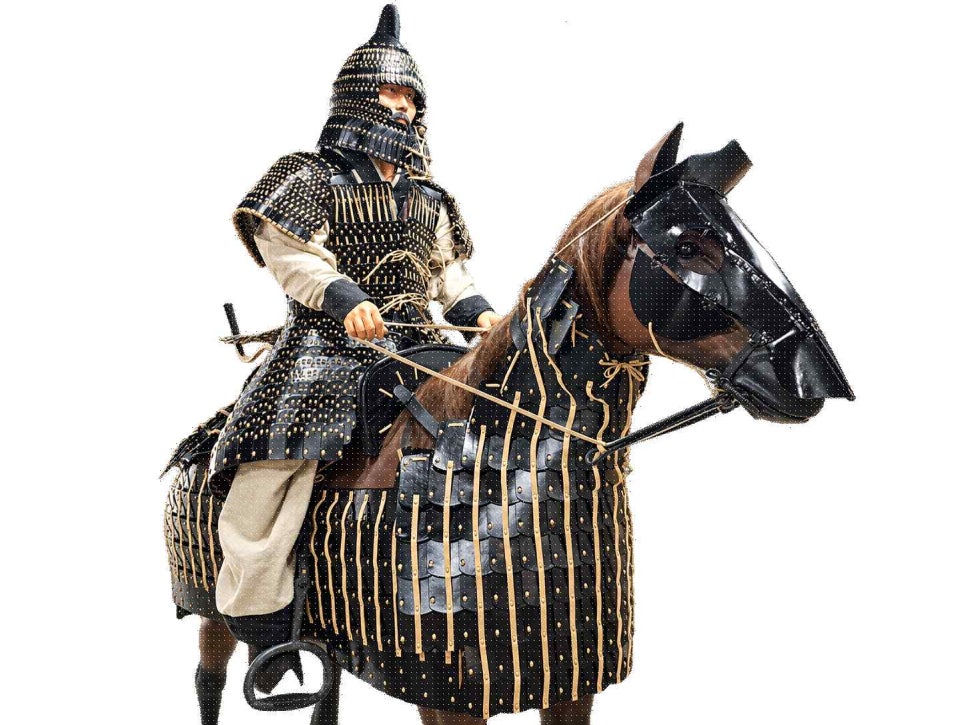
Reproductions of the lacquered armour and horse armour (released 2026)
Photo: Korea Heritage Service · KOGL Type 1
What can you see at Gongsanseong now?
Gongsanseong is open all year. Walking the circuit of the walls brings you past Ssangsujeong pavilion, and the ground around it is the palace site described here. The 11 November site tour was a one-off, and no regular public opening of the excavation has been announced, so expect to look in from outside the fencing. Winter hours are shorter: from November to February the fortress closes at 17:00.
Visiting Gongsanseong (Gongju city tourism page)
- Address
- 280 Ungjin-ro, Gongju, South Chungcheong Province
- Admission
- Adults KRW 3,000 · youths and soldiers KRW 2,000 · children KRW 1,000
- Groups of 20 or more
- Adults KRW 2,500 · youths and soldiers KRW 1,500 · children KRW 500
- Hours
- March to October 09:00 to 18:00 · November to February 09:00 to 17:00 (last entry 30 minutes before closing)
- Closed
- Lunar New Year's Day, Chuseok Day, 1 January
Check fees and hours before you go
Prices and hours come from the Gongju city tourism site, and an older admission-fee table on the same site still lists 09:00 to 18:00 all year. A combined ticket also covers the Royal Tombs of King Muryeong and Seokjangni Museum; confirm at the ticket office.
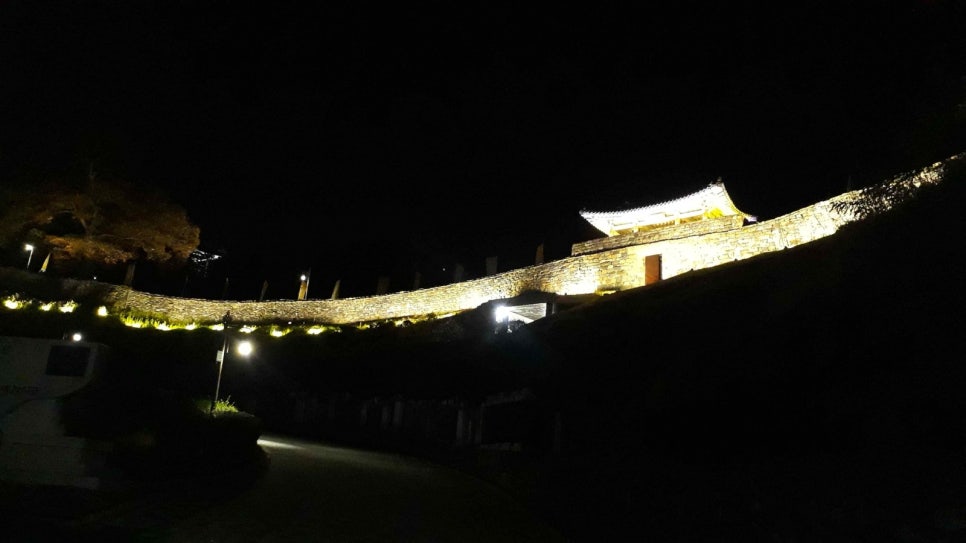
Floodlit walls and a gate pavilion at Gongsanseong (released 2019; the pavilion is not named in the source)
Photo: Korea Heritage Service (then the Cultural Heritage Administration) · KOGL Type 1
Getting there, and how much is in English
Gongju has no subway or KTX station in town, so most visitors from Seoul come by intercity or express bus and then take a local bus or taxi to the fortress, which sits on the south bank of the Geum River near the city centre. The fortress is a ticket-at-the-gate site: no booking, no Korean phone number needed. The detailed findings in this article come from a Korean-only press release, and we could not confirm that English panels explain the palace site on the ground, so reading this before you go is the practical way to make sense of what you are looking at. The Royal Tombs of King Muryeong, covered by the combined ticket, are a short ride away and make a natural half-day pairing.
Frequently asked questions
- Q. Was the Gongsanseong palace gate just discovered?
- No. The gate was first identified in 2019, the first of its kind found in Korea. The Korea Heritage Service announcement on 11 November 2026 summarised excavations that have run since 1980.
- Q. How big is the palace gate at Gongsanseong?
- According to the Korea Heritage Service, each tower measures about 40 m east to west and 23 m north to south and stood about 9 to 11 m high. A 10 m road runs between the two towers.
- Q. When was Gongju the capital of Baekje?
- From 475 to 538, when the city was called Ungjin. It was Baekje's second capital, for 64 years, before the court moved to Sabi (Buyeo).
- Q. Can I visit the excavation at Gongsanseong?
- The public site tour took place once, on 11 November 2026, and no regular opening has been announced. Gongsanseong Fortress itself is open all year, so you can see the area around Ssangsujeong from the fortress paths.
- Q. Is it worth going if I do not read Korean?
- Yes, if you come prepared. The fortress walk and the river views need no Korean and there is nothing to book, but the palace-site findings are published only in Korean, so read up beforehand rather than counting on signs at the dig.
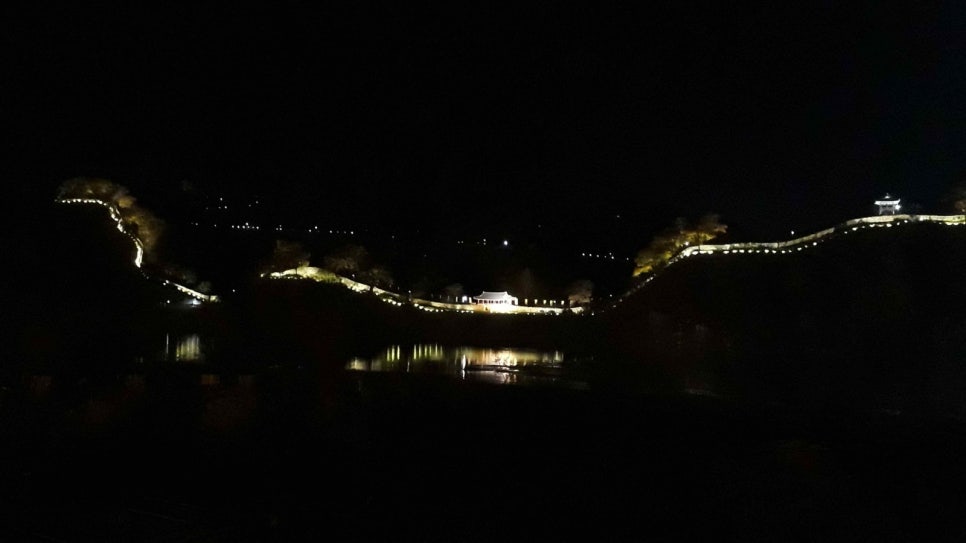
Gongsanseong's walls under floodlights (released 2019)
Photo: Korea Heritage Service (then the Cultural Heritage Administration) · KOGL Type 1
Editor's note · Kang Shin-wook
For anyone visiting Gongju or touring the Baekje Historic Areas World Heritage sites in Gongju, Buyeo and Iksan, this explains why the ground around Ssangsujeong pavilion matters before you walk it. Royal palaces and other heritage sites in Seoul are compared in Seoul's royal palaces: tickets and closing days.
Sources
Written in our own words from the sources above, never copied from them, and every date and price checked against at least two pages. The originals are in Korean. Spotted a mistake? Ask for a correction.
Latest from Korea Heritage Service
 Korea Heritage ServiceEvent14 November 2026In 3 daysFreeK-Craft House at The Hyundai Seoul: heritage crafts pop-up — 21–29 Nov, free
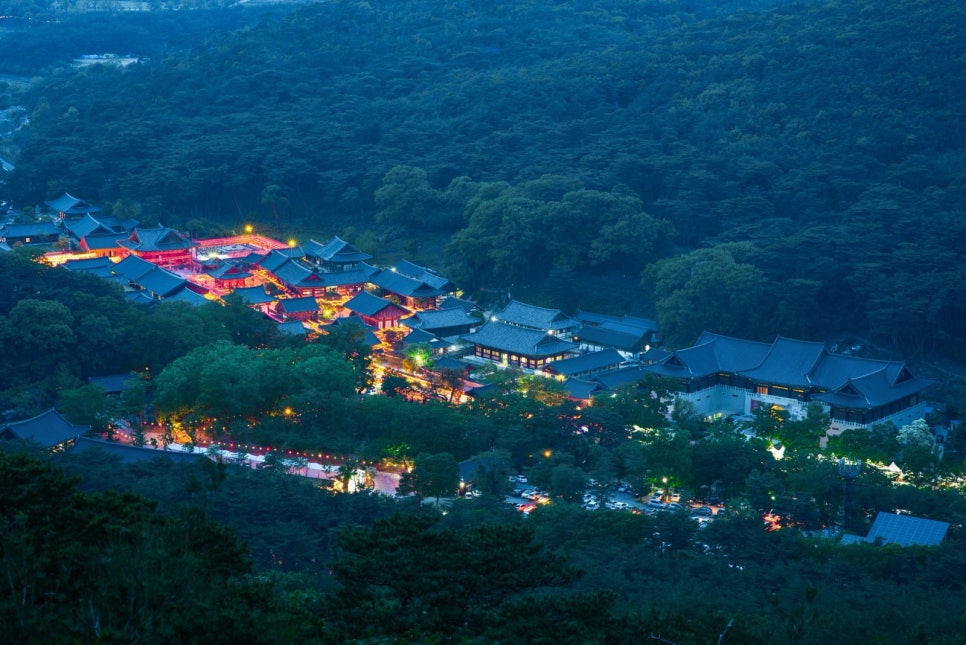 Korea Heritage ServiceEvent13 October 2026EndedFreeTongdosa, Cheongju, Yeosu: heritage media art to 8 Nov, free
 Korea Heritage ServiceEvent6 October 2026EndedFreeTongdosa Temple media art nights, Yangsan — free until 18 October