Programme·Royal Palaces and Tombs CenterIn 9 daysFree
Gyeongbokgung's palace soy-sauce store opens free, 4–8 November 2026
Summary
The Janggo, the walled yard at Gyeongbokgung where the royal kitchen kept its jars of soy sauce and soybean paste, opens from 4 to 8 November 2026, 10:00 to 17:00 daily. The exhibition on Korea's UNESCO-listed jang-making culture, the short costumed play and the photo spot are free and need no booking, and the palace itself is free to enter from 29 October to 15 November. The catch: the paid hands-on jang-making session (KRW 50,000 for a pair) was booked on Ticketlink and every slot showed sold out on 25 October, and it requires coming back in March 2027.
Article
In short
- The Janggo (royal sauce store) at Gyeongbokgung opens for five days, 4–8 November 2026, 10:00–17:00 daily; the exhibition, short play and photo spot are free and need no booking.
- Gyeongbokgung is also free to enter from 29 October to 15 November 2026 (closed Tuesdays) for the Korea Grand Festival, according to the Royal Palaces and Tombs Center notice; November last entry is 16:00.
- The paid jang-making session runs 6–8 November, four times a day, at KRW 50,000 for a pair; booking opened on Ticketlink on 21 October and every slot showed sold out on 25 October.
- Participants leave their jar to ferment in the Janggo for about four months and return in spring 2027 (5–7 March, planned) to divide it into soybean paste and soy sauce.
- For a visitor who reads no Korean, the free walk-in programme is the realistic option: the panels and play are in Korean, but the jars and the yard need no translation.
The Royal Palaces and Tombs Center of the Korea Heritage Service and the Korea Heritage Agency are opening the Janggo at Gyeongbokgung for this year's Recreating Daily Life in the Palace programme. The Janggo is the enclosure where the court kept the earthenware jars of jang — soy sauce, soybean paste and chilli paste — for the royal kitchen, and it is normally closed. From 4 to 8 November it holds a panel exhibition on Korean jang-making culture, added to UNESCO's intangible heritage list in 2024, along with a short play and a photo spot. The point of the event is that anyone who has come into the palace can walk in without signing up.

The press release splits the event in two: a free walk-in programme on all five days, and a paid, pre-booked hands-on session on three of them (6–8 November). The session sold out within days, so for anyone planning now, the free programme is the one to build a visit around.
What is the Janggo at Gyeongbokgung?
The Korea Heritage Service describes the Janggo as the place where Gyeongbokgung stored and looked after the royal sauce jars. Earlier press releases (2020 and 2023) add that the sauces for banquets, ancestral rites and the king's table were kept here, watched over by a kitchen court lady known as Janggo Mama (장꼬마마). Today's Janggo was rebuilt in 2005 and holds jars collected from across the country.
At this event the court lady's title returns twice: as a character in the short play, and as the name used for the master who leads the jang-making session. Expect to see the same word on signs meaning two different people.

This is not the first opening. Press releases from the Cultural Heritage Administration (now the Korea Heritage Service) record the Janggo opening in October 2020 with demonstrations of royal sauce dishes, and for two weeks in May–June 2023 with panels on ingredients and tools. What has not changed is that it opens only for set events, never year-round.
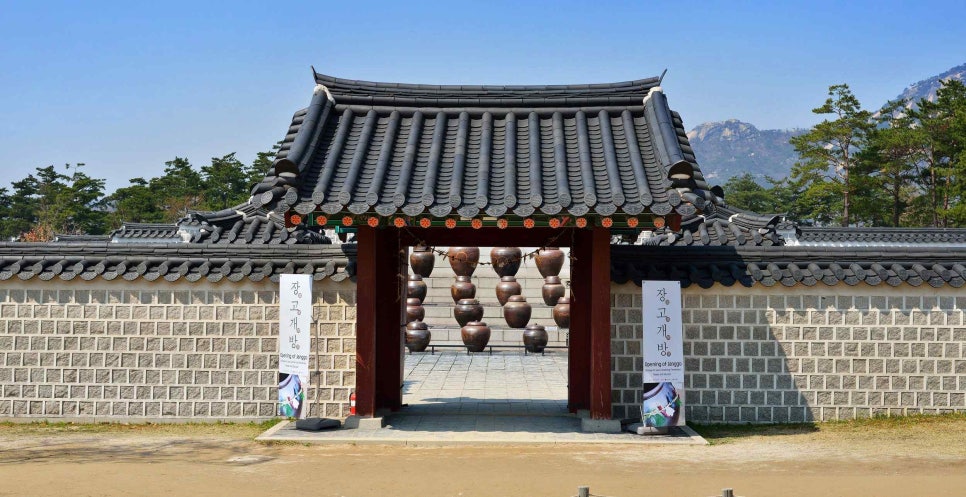

What can you see without booking?
Everything on site from 4 to 8 November, 10:00 to 17:00, is free. The press release names an exhibition on Korean jang-making culture, a photo spot set in the Janggo and short costumed plays. The Royal Palaces and Tombs Center's event poster, which we summarised on our blog, breaks this down further:
- A special exhibition on Korean jang-making culture, UNESCO-listed in 2024
- Tying a written wish for the year onto a geumjul, the straw rope traditionally wound round sauce jars to keep bad luck out
- A short play, Janggo Mama's Inspection, in which the court lady and her maids make a surprise check of the store
- The Secret of the Flavour — collect four QR codes (chilli, charcoal, bamboo salt water, straw rope) around the yard for a small gift
- A photo spot in the Janggo
The on-site programme may change
The detailed programme names come from the event poster; the press release itself mentions only the exhibition, photo spot and short plays. The poster also says on-site events are scaled down when 5 mm or more of rain is forecast, so if rain is expected, call the programme line (+82 1522-2295) first.
How do the free programme and the jang-making session differ?
Both take place in the Janggo, but the cost and how you join are different. The tables combine the outline attached to the press release with Ticketlink's product notes.
Janggo visit and on-site programme
- Dates
- 4 (Wed) – 8 (Sun) November, 5 days
- Hours
- 10:00–17:00
- Cost
- Free
- Booking
- None — walk in
- Who
- Anyone visiting Gyeongbokgung
Jang-making session
- Dates
- 6 (Fri) – 8 (Sun) November, 3 days, plus jang dividing on 5–7 March 2027 (planned)
- Times
- 10:00 / 11:20 / 14:00 / 15:20, 50 minutes each
- Cost
- KRW 50,000 per pair · 50% off for registered disabled people and holders of a veterans' registration card
- Booking
- Ticketlink, first come first served, from 21 October 14:00
- Capacity
- 10 pairs (20 people) per slot, one 20-litre jar per pair
- Condition
- Both the autumn and the spring visit (missing spring means no refund and no sauce, per Ticketlink)
Can you still book the jang-making session?
Booking opened on Ticketlink at 14:00 on Wednesday 21 October, first come first served. When our blog checked early on 25 October, all 12 slots from 6 to 8 November showed sold out. Returned tickets are the only way in: Ticketlink allows cancellation until 16:00 two days before the session and closes sales at 18:00 the same day, so the product page is worth rechecking until then.
If you do get a returned ticket: one ticket covers the booker and one companion, and each account can buy only one. The discount must be chosen at booking, and proof — a disability card or veterans' card — is checked on the day. Bring original photo ID and the booking number to the check-in booth by the Janggo 20 minutes before the start. The event poster says the session is for school-age children aged 8 and over (under-18s with a guardian) and that payment is by credit card only.
How does the session run?
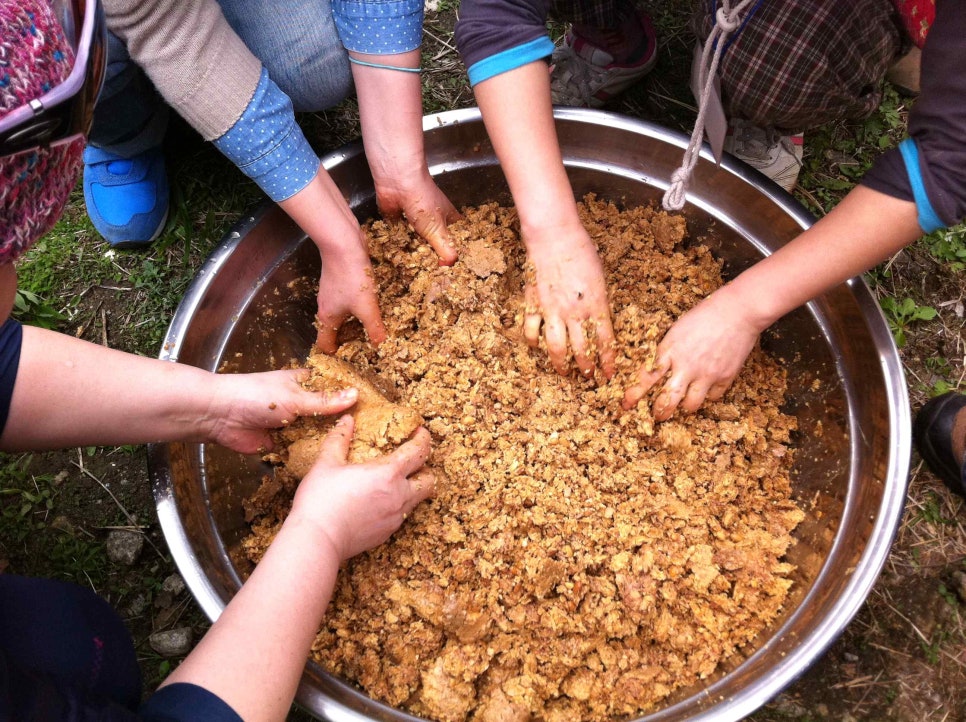
It is led by Ki Sun-do, designated Korean Food Grand Master for traditional jang (No. 35). The first 25 of the 50 minutes are a talk on jang and its UNESCO listing; in the next 20, each pair makes sauce in its own 20-litre jar, ties on a straw rope and hangs a name tag; the last five hand out the QR code for the spring visit. The poster says participants pour in bamboo-salt brine and float charcoal, chillies and jujubes themselves.
The photos below are not from this session. They are record photos the Korea Heritage Service released for the UNESCO listing of Korean jang-making culture in 2024.


The licence on these photos is stated two ways
Three record photos of jang making and dividing are marked as KOGL Type 1 (open, attribution only) on the December 2024 press release page, but as Type 4 (non-commercial, no derivatives) on the Heritage Portal's jang-making entry. We therefore credit the source and do not claim a licence for them.
When do participants take their sauce home?
The session takes two visits. Sauce made in autumn ferments over winter in the Janggo for about four months, and the same participants come back in spring 2027 (5–7 March, planned) to lift out the soybean blocks and separate soybean paste from soy sauce. Spring slots are fixed to match the autumn ones and, according to the poster, run four times a day (10:00, 11:40, 14:00, 15:40; one hour each): 20 minutes on kinds of soy sauce and how to use them, 35 minutes of dividing, packing and photos, and five minutes to finish.

While November's sauce matures until March, the palace goes through midwinter. The next photo is not the Janggo but Geunjeongjeon, the throne hall, under snow — the season in which the sauce is ageing.

Why jang-making, and why now?
The background is the UNESCO listing. Jang-making was designated a national intangible heritage in December 2018 as a practice carried on by communities rather than named masters, and Korean jang-making culture was inscribed on UNESCO's Representative List of the Intangible Cultural Heritage of Humanity on 3 December 2024 (local time), at the 19th session of the Intergovernmental Committee in Asunción, Paraguay. The Korea Heritage Service presents this event as a chance to open the normally closed Janggo, recreate royal food culture and showcase that listed heritage.
What to check before you go
- Opening: 4 (Wed) – 8 (Sun) November, 10:00–17:00; the Janggo is free and needs no booking
- Palace admission: free from 29 October to 15 November (closed Tuesdays), per the 30 September notice — none of the five event days is a Tuesday
- Last entry: Gyeongbokgung's November hours are 09:00–17:00, with last admission at 16:00
- Where: the Janggo area inside Gyeongbokgung, west of Hyangwonjeong Pavilion on the event map
- Tours: regular guided tours run 30 minutes shorter during the free-admission period
- Contact: programme line +82 1522-2295 / Ticketlink +82 1588-7890

Getting there, and how much is in English
Take Seoul Subway Line 3 to Gyeongbokgung Station; the palace entrance is a short walk through the underground passage, and Gwanghwamun Station (Line 5) is about ten minutes on foot from the main gate. Once inside, head north past Gyeongbokgung's main halls towards Hyangwonjeong Pavilion — the Janggo is just west of it. Palace signs and maps are in English as well as Korean, and the palace's free English guided tours start from the information point inside the gate; they cover the palace, not this event. The Janggo panels, the play and the jang-making session are prepared for Korean visitors, and no English version has been announced. The paid session is sold through Ticketlink's Korean site, which normally needs Korean mobile identity verification; with every slot already gone, a non-resident is best served by the free walk-in programme, where the jar yard itself is the sight.
Frequently asked questions
- Q. When is the Gyeongbokgung Janggo open?
- From Wednesday 4 to Sunday 8 November 2026, 10:00 to 17:00 every day. The exhibition, play and photo spot are free and need no booking.
- Q. Do I have to pay to enter Gyeongbokgung to see the Janggo?
- No. The Janggo programme is free, and the Royal Palaces and Tombs Center's notice says Gyeongbokgung itself is free to enter from 29 October to 15 November 2026 (closed Tuesdays), which covers all five event days.
- Q. How much is the jang-making session and how do I book it?
- It costs KRW 50,000 per pair, with 50% off for registered disabled people and veterans' card holders. Booking opened on Ticketlink at 14:00 on 21 October, and all 12 slots showed sold out on 25 October; returned tickets can appear until two days before each session.
- Q. When do participants collect the sauce they make?
- After about four months of fermenting in the Janggo, at the jang-dividing session on 5–7 March 2027 (planned). Participants who cannot come back in spring get neither a refund nor their sauce.
- Q. Has the Janggo been opened before?
- Yes. Rebuilt in 2005, it has opened for set events, including October 2020 and May–June 2023. It is closed the rest of the time.
- Q. Is it worth going if I do not read Korean?
- Yes, if you are at Gyeongbokgung that week anyway: entry to the palace and the Janggo is free, and the rows of sauce jars in a normally locked yard are the main sight. The panels and the short play are in Korean, and the hands-on session is sold out and booked through a Korean-only site, so do not travel just for those.
Editor's note · Kang Shin-wook
For anyone in Seoul in the first week of November who wants a corner of Gyeongbokgung that is normally locked, and for food travellers curious about Korean fermented sauces. Palace hours, fees and English tours are on our Royal Palaces and Tombs guide; other palaces are compared on Palaces and royal tombs.
Sources
- Official notice (Korean)
- Royal Palaces and Tombs Center event page — Gyeongbokgung Janggo Story (Korean)
- Royal Palaces and Tombs Center notice on October–November 2026 Gyeongbokgung opening, 30 Sep 2026 (Korean)
- Cultural Heritage Administration press release on the 2023 Janggo opening (Korean)
- Cultural Heritage Administration press release on the 2020 Janggo opening (Korean)
- Ticketlink product page, 2026 Recreating Daily Life in the Palace (Korean)
Written in our own words from the sources above, never copied from them, and every date and price checked against at least two pages. The originals are in Korean. Spotted a mistake? Ask for a correction.
Latest from Royal Palaces and Tombs Center
 Royal Palaces and Tombs CenterProgramme24 October 2026In 15 daysDonggwol Dongnak 2026, Seoul palaces by night — ballot to 28 Oct
 Royal Palaces and Tombs CenterProgramme24 October 2026In 8 daysFreeGeonwolleung's silver-grass mound opens — 3–8 November 2026
 Royal Palaces and Tombs CenterProgramme20 October 2026Ending soonFreeGyeonghoeru and Hyangwonjeong tour, Gyeongbokgung — last dates 23, 28 and 30 October
 Royal Palaces and Tombs CenterEvent20 October 2026In 3 daysFreeSeoul's palaces, Jongmyo and royal tombs free — 29 Oct to 15 Nov 2026