Notice·Royal Palaces and Tombs Center
AI patrol robots at Deoksugung and Seooreung — wheels or legs, until November 2026
Summary
The Korea Heritage Service's Royal Palaces and Tombs Center is field-testing two AI patrol robots from August to November 2026: a four-wheeled robot at Deoksugung Palace in central Seoul and a two-legged walking robot at the Seooreung royal tombs in Goyang, one at each site. They navigate by LiDAR and vision AI and use ordinary and thermal cameras to spot fire, intruders and visitors who have collapsed, relaying guidance and warnings through the control room. It is a technology trial, not a visitor event: there is nothing to book and no extra charge, and both sites keep their usual hours and admission. Whether you actually meet a robot is down to luck, since patrol routes and times have not been published.
Article
In short
- The trial runs from August to November 2026 and may be extended into 2027 depending on the results.
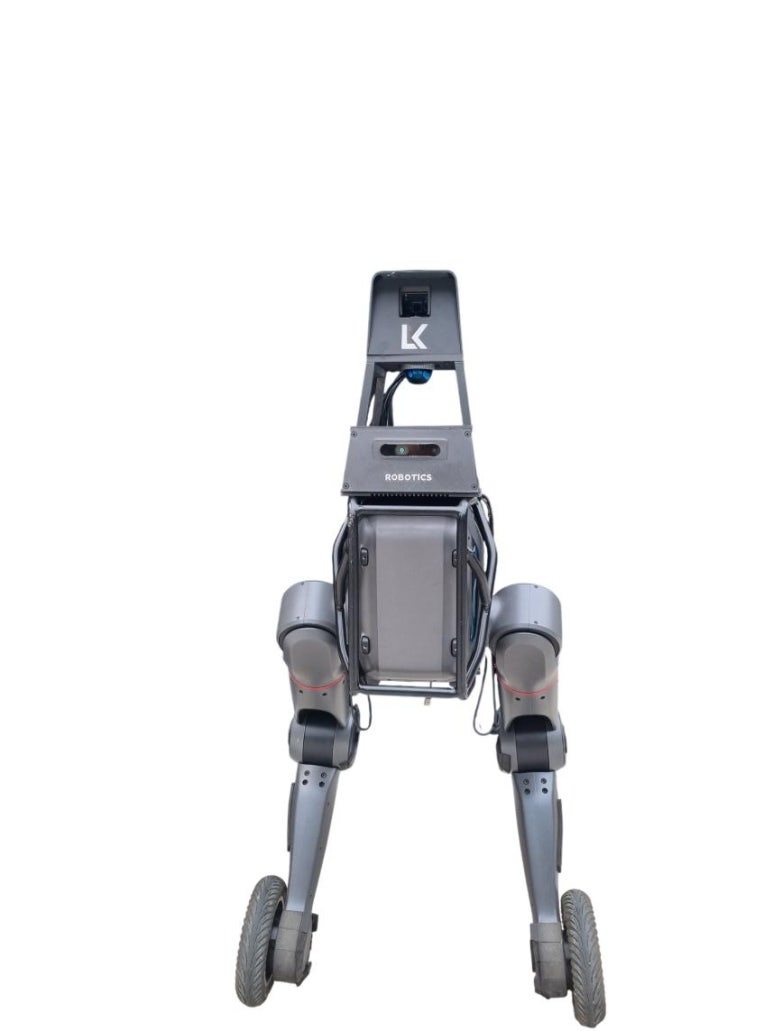
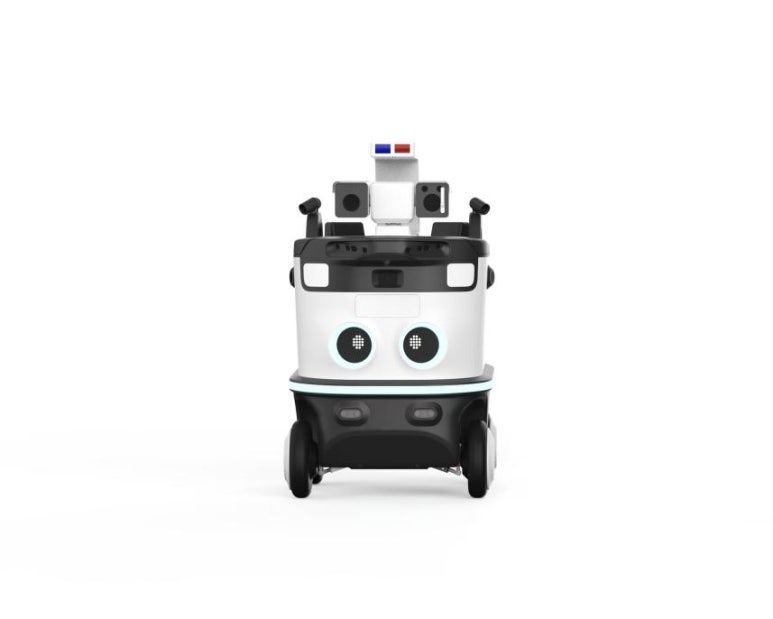
- Deoksugung gets one four-wheel-drive robot and the Seooreung tombs in Goyang one two-legged walking robot — an experiment comparing the two on a flat palace and a sloping tomb site.
- The robots navigate autonomously by LiDAR and vision AI, detect fire, intruders and collapsed visitors with ordinary and thermal cameras, and put out guidance and warning broadcasts linked to the control room.
- It is not a visitor event: nothing to book, no extra charge, and the hours and admission at Deoksugung and Seooreung are unchanged. It follows a pilot the Center ran at Changdeokgung on its own budget from February 2026, and is funded under the Ministry of SMEs and Startups' AI Patrol Robot Demonstration Project.
- For a visitor who reads no Korean: admission is at the gate with cash or card, Deoksugung is signed in English, and the robots' announcements are not described in any language — if you meet one, simply do not stand in its way.
Where the night-watch patrols of the Joseon capital once walked, a robot now takes its turn. In a press release of 21 August 2026 the Korea Heritage Service's Royal Palaces and Tombs Center announced field trials of artificial-intelligence patrol robots at Deoksugung Palace and the Seooreung royal tombs in Goyang. The point is not adoption but comparison: a robot that runs on wheels and one that walks on two legs are being placed on different kinds of ground, and data on which type suits palaces and royal tombs will be gathered until November.
Why different robots for Deoksugung and Seooreung
The Center says the terrain decided the robots' legs. Deoksugung, where the paths between the halls are mostly level, gets a robot that rolls on four wheels; Seooreung, with grass slopes climbing to the burial mounds and ramps between them, gets one that walks. This is not one specification split between two sites: from the outset two different modes of movement are placed in two different environments so that driving performance, obstacle handling and surveillance and detection can be compared.
The two trial sites compared
- Robot type
- Deoksugung: one four-wheel-drive robot / Seooreung: one two-legged walking robot
- Why
- Deoksugung is flat; Seooreung has rough ground and slopes
- Heritage type
- Deoksugung is a palace; Seooreung is a cluster of Joseon royal tombs (Historic Site: Seooreung, Goyang)
- Shared technology
- LiDAR and vision-AI autonomous navigation, ordinary and thermal cameras, AI video analysis
- Maker and model
- Not disclosed in the press release or in any news report
What the robots detect, and what they do about it
The press release names three things to detect: fire, intruders, and the emergency of a visitor collapsing. What sets this apart from CCTV is that detection is not the end of it — the robot is linked to the control room and also handles on-the-spot guidance and warning broadcasts.
- LiDAR — a sensor that maps the surrounding space and obstacles with laser light. It is what lets the robot move between halls, stone figures and trees without collisions.
- Vision AI — AI analysis of the camera feed that identifies objects, behaviour and abnormal situations, and works out the robot's own position and a drivable route.
- Thermal camera — picks up temperature changes invisible to the eye, catching the early signs of fire.
- Control-room link — when something is detected, the robot works with the control room to put out guidance and warning broadcasts.

What palaces and royal tombs look like to a robot
Palaces and Joseon royal tombs have only one thing in common: they are large outdoor heritage sites. The Korea Heritage Service explains that with many kinds of heritage and structures scattered across wide grounds, and narrow winding paths, ramps, unpaved stretches and trees all mixed together, each site demands different driving performance and obstacle handling. That is why the emphasis is less on confirming an individual robot's performance than on testing which type fits which site.
What the Changdeokgung 'Sullabot' pilot showed
This trial did not come out of nowhere. From February 2026 the Center ran one patrol robot at Changdeokgung on its own budget, and on the strength of that it was selected for the Ministry of SMEs and Startups' demonstration project and moved on to this follow-up. The details of the Changdeokgung robot below come not from the official press release but from news coverage of a demonstration held in front of the Yeonghwadang pavilion in Changdeokgung's rear garden on 20 February 2026.
- Name — 'Sullabot', reported to be named after the sulla, the night patrols of the Joseon capital.
- Maker — Dogu Gonggan Co., introduced at the demonstration as a product built entirely with domestic technology.
- Specification — 115.3 cm tall, 120 kg, a travelling speed of 0.7 m per second, and able to climb slopes of up to about 15 degrees.
- Sensors — four-way sensors, LiDAR, a thermal camera, a high-sensitivity microphone and an air-quality sensor.
- Operation — two patrols by day and seven by night at two-hour intervals. The price was reported as about KRW 80 million per unit.
- Limits — it struggles on lawns, in snow deeper than 3 cm and in heavy rain, and cannot cross a threshold higher than 5 cm.
The pilot's dates differ between sources
The Korea Heritage Service press release describes the Changdeokgung pilot as running for two months from February this year, while the Seoul Economic Daily reported roughly one month, from 10 February to 9 March. This article uses the broader 'February–March 2026'. Whether the maker of the Changdeokgung robot is also taking part in the Deoksugung and Seooreung trial has not been confirmed.
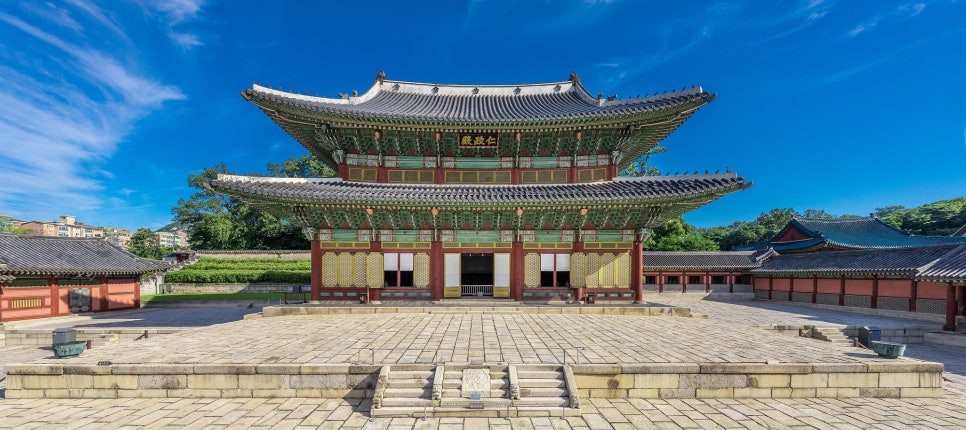
How much ground is there to cover?
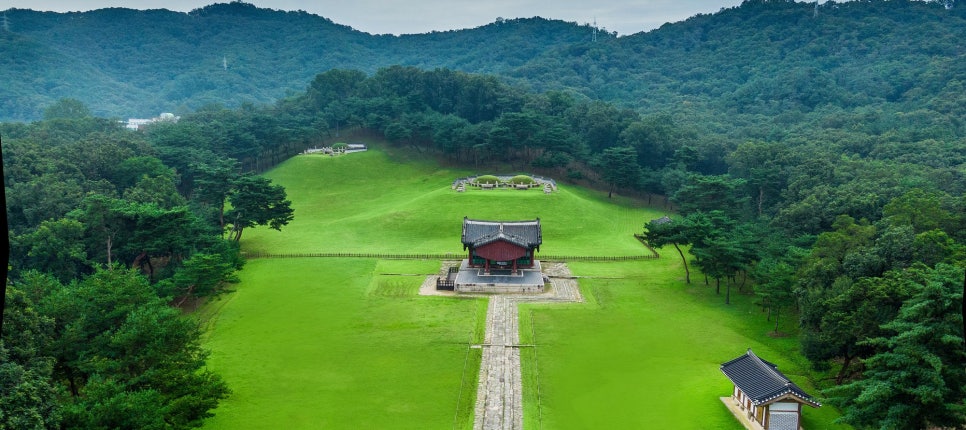
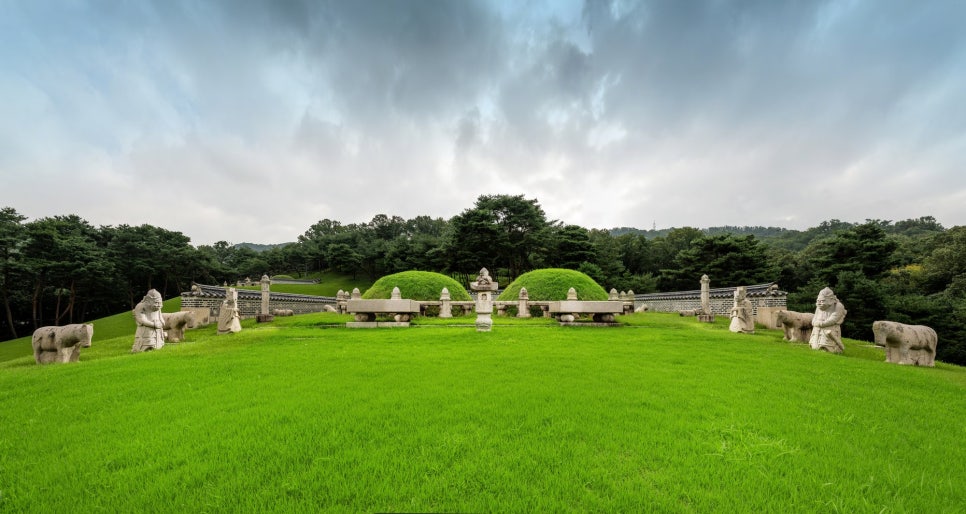
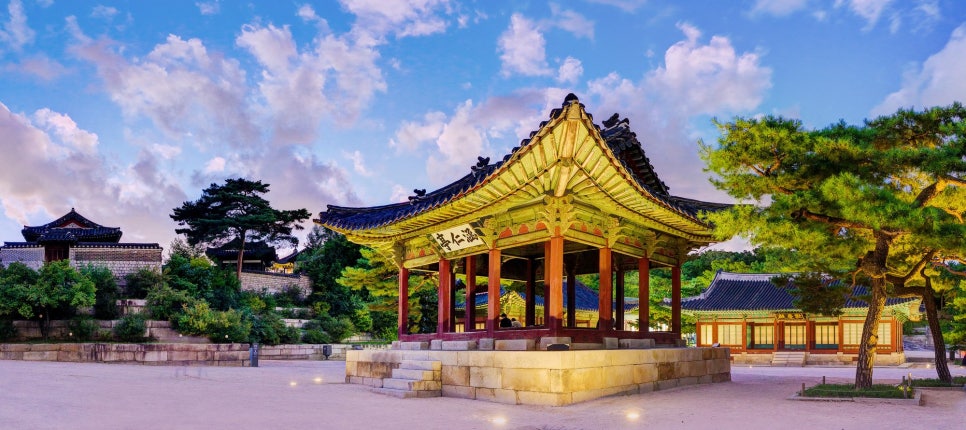
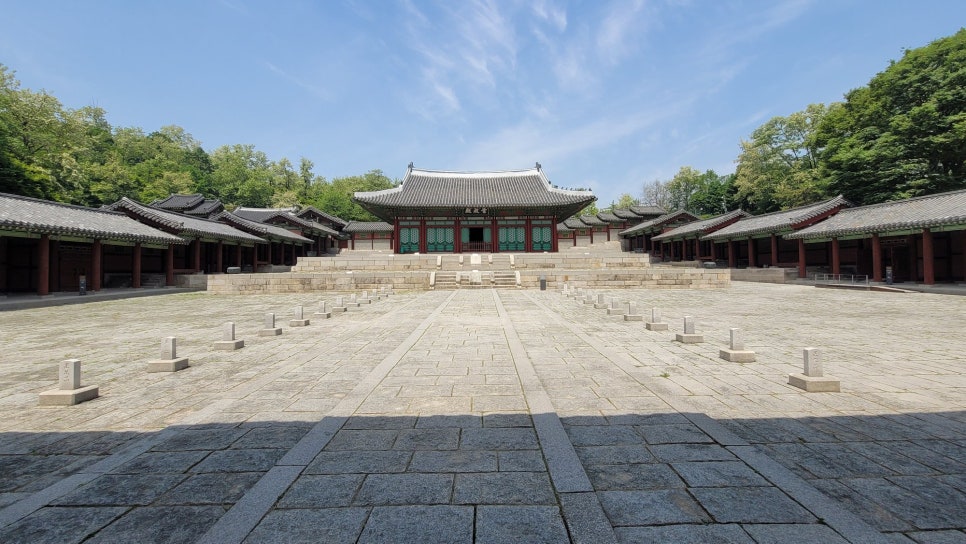
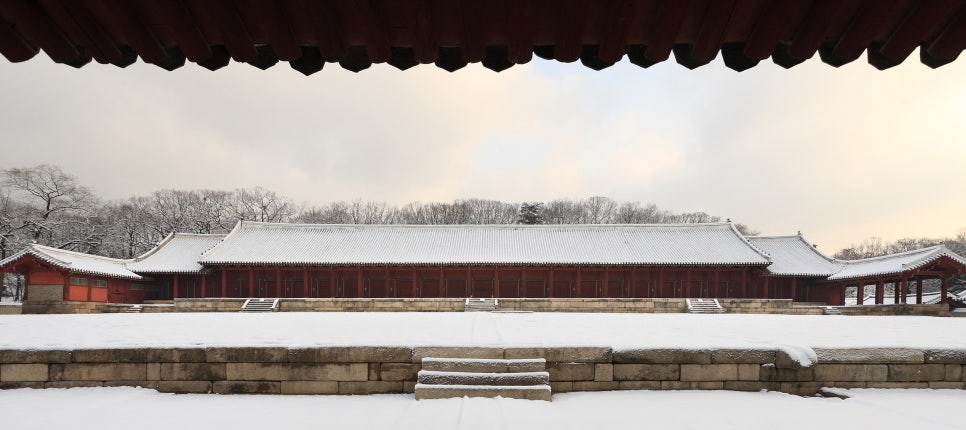
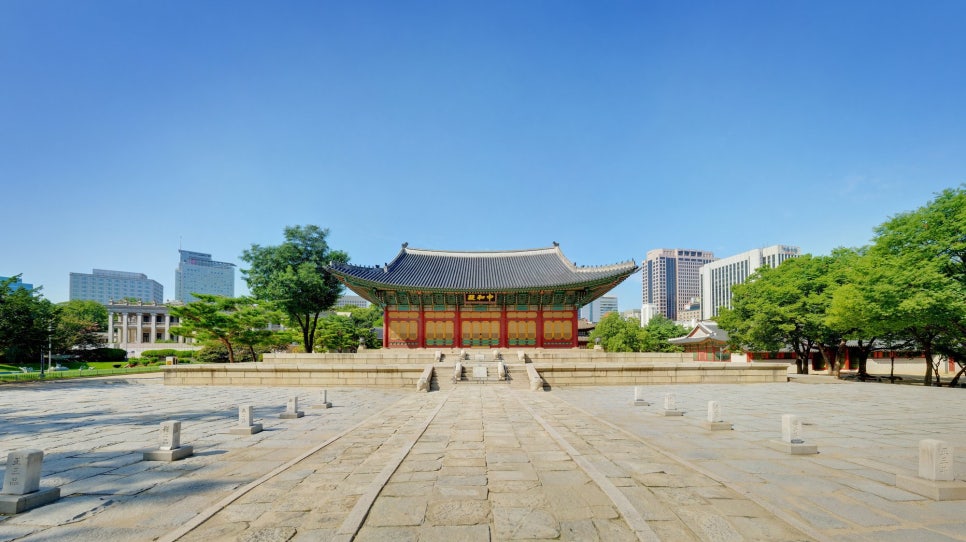
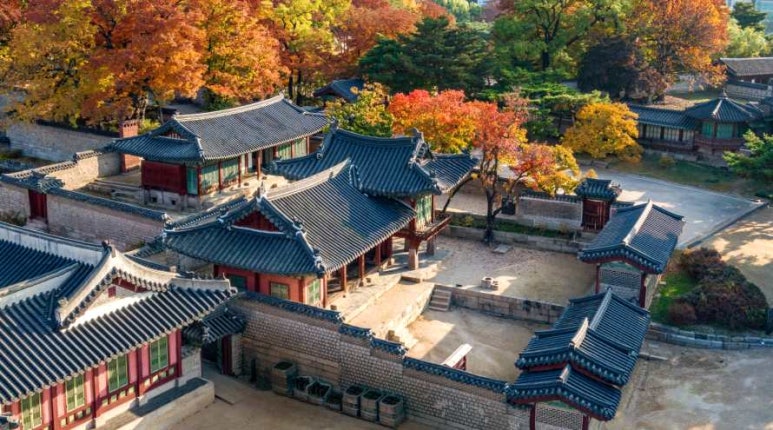
Think of the palaces, Jongmyo Shrine and the royal tombs the Center manages and it becomes clear why autonomous driving is a hard problem here. The photographs below are not of the trial sites, but they show the pattern: wooden halls hundreds of years old around wide courtyards, with steps and changes of level running on from one another. At this stage the realistic goal is not for one robot to cover such grounds in full, but for it to act as a moving CCTV camera that keeps watch over the blind spots people tend to miss.
What visitors should know
- It is not a visitor programme. This is a trial of safety technology, so there is no robot experience or demonstration to attend.
- There is no guarantee of seeing a robot. Patrol routes and times have not been published, and there is only one robot at each site.
- If you meet one, do not block its path. A LiDAR-guided robot stops or goes round when it detects an obstacle, so standing in front of it only delays the patrol.
- Hours and admission at Deoksugung and Seooreung are unchanged. No notice says the trial alters visiting conditions.
- Enquiries about the project go to the Center's Restoration and Maintenance Division (+82-2-6450-3849, +82-2-6450-3848), in Korean.
Getting there, and what to expect on the day
Deoksugung is the easy one: City Hall Station on Lines 1 and 2, and the main gate, Daehanmun, is a minute from the exits. It is open from 9:00 am to 9:00 pm all year with last admission at 8:00 pm, closed on Mondays, and adult admission (ages 25 to 64) is KRW 1,000, bought at the gate with cash or a card; under-25s, over-65s and anyone in hanbok go in free. There is nothing to book and no Korean phone number or account comes into it. Signage inside is bilingual, and the palace website has English pages, so the visit works without any Korean. Seooreung is a different sort of trip: the tombs lie in Goyang, north-west of Seoul, reached by bus from Yeonsinnae Station on Lines 3 and 6 — allow well over an hour from the centre and check the bus on a map app before you go. In September and October the tombs are open from 9:00 am to 6:00 pm with last admission at 5:00 pm, closed on Mondays, and the main information boards are bilingual while the rest of the signage is largely Korean. At both sites the robot, if you come across it at all, is a working patrol and not an exhibit: the press release does not say what language its announcements use, so if it speaks, assume Korean, step aside, and let it pass.
Frequently asked questions
- Q. How long will the AI patrol robot be at Deoksugung?
- The trial runs from August to November 2026. The official material gives months only, so the exact start and end dates are not published, and it may be extended into 2027 depending on the results.
- Q. What kind of robot is at Seooreung?
- One two-legged walking robot. Walking was chosen for the rough ground and slopes of the tomb site, while flat Deoksugung gets one four-wheel-drive robot.
- Q. Do the palace patrol robots run at night?
- The patrol hours for the Deoksugung and Seooreung trial have not been published. During the Changdeokgung pilot the robot was reported to patrol seven times a night at two-hour intervals, but whether the same pattern applies here has not been confirmed.
- Q. Who makes the patrol robots?
- The Korea Heritage Service has not disclosed the maker or model of the robots in this trial. The robot piloted at Changdeokgung in February 2026 was reported to be made by Dogu Gonggan Co., but it has not been confirmed that the same company is taking part this time.
- Q. Will robots replace the palace guards?
- No. The press release describes the robots as supporting the existing patrols, which are carried out by people, and during the Changdeokgung pilot the robot was presented as a round-the-clock helper covering the blind spots that CCTV cannot reach.
- Q. Is it worth going if I do not read Korean?
- Go for the palace or the tombs, not for the robot. Deoksugung is fully signed in English, admission is KRW 1,000 at the gate with nothing to book, and it is open until 9:00 pm; Seooreung is a quiet, mostly Korean-signed site that takes a bus ride from Seoul. Seeing a robot at either is a matter of luck, and nothing about the trial is explained on site in any language.
Editor's note · Kang Shin-wook
For anyone planning a visit to Deoksugung or Seooreung this autumn, and for anyone curious how robots and AI are being brought onto heritage sites. We set the Korea Heritage Service's press release against the news coverage of the earlier Changdeokgung pilot. Hours, admission and how to reach the palaces and tombs are in our Royal Palaces and Tombs Center visiting guide.
Sources
- Official notice (Korean)
- Robot Newspaper (irobotnews.com), Korea Heritage Service to field-test patrol robots at Deoksugung and Seooreung after Changdeokgung, 21 August 2026 (Korean)
- Aju Business Daily, which robot guards a palace better — AI patrol robots compared, 21 August 2026 (Korean)
- Seoul Economic Daily, 20 Feb 2026 — the Changdeokgung patrol robot's specification, maker and limits (Korean)
- News1, Sullabot on trial patrol at Changdeokgung, 20 February 2026 (Korean)
- Royal Palaces and Tombs Center, hours and admission for palaces and royal tombs (Korean)
- Royal Palaces and Tombs Center, admission information (English)
Written in our own words from the sources above, never copied from them, and every date and price checked against at least two pages. The originals are in Korean. Spotted a mistake? Ask for a correction.
Latest from Royal Palaces and Tombs Center
 Royal Palaces and Tombs CenterEvent11 October 2026Last dayFreeChangdeokgung Secret Garden: read inside a royal library — until 18 October
 Royal Palaces and Tombs CenterEvent11 October 2026On nowJoseon royal tomb forest trails open for autumn — until 29 November
 Royal Palaces and Tombs CenterProgramme25 September 2026On nowFreeGenre Painting for All 2026: make a Joseon character — free to 1 Nov
 Royal Palaces and Tombs CenterExhibition22 September 2026On nowFreeChangdeokgung opens the Huiuru pavilion for the first time, 22 September to 8 November