Programme·National Folk Museum of KoreaOn nowFree
Folk Museum ghost-story evenings — all five sessions full, how cancellations work
Summary
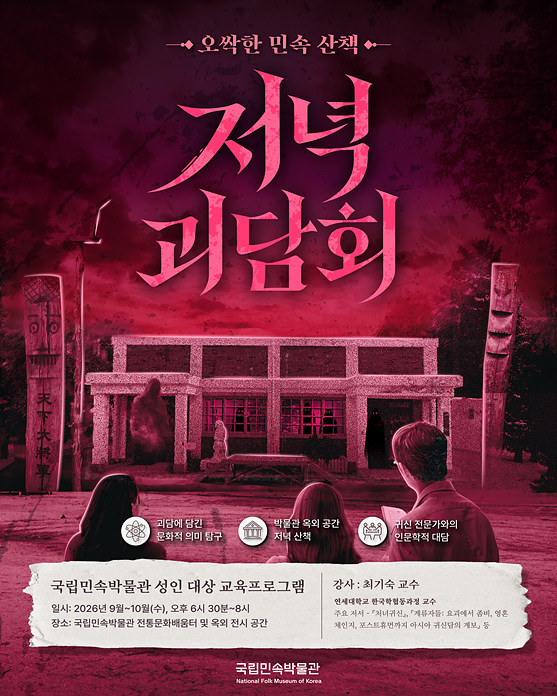
The National Folk Museum of Korea in Seoul is running Evening Ghost Stories: A Chilling Folk Walk, an adults-only programme, on five Wednesday evenings from 16 September to 28 October 2026 — a 20-minute walk through the museum's outdoor exhibits after dark, then a 50-minute lecture. It is free, but with only 20 places per session all five filled within days of applications opening, and the first evening has already taken place. Each session's application form stays open until 1:00 pm the day before, so a cancelled place can still be picked up until then. The catch for a visitor: the application page, the walk and the lecture are all in Korean, with no interpretation.
Article
In short
- Five Wednesday evenings from 16 September to 28 October 2026, 6:30 – 8:00 pm: 16 and 30 September, 7, 14 and 28 October.
- Free, with 20 adult places per session and one application per person.
- All five sessions were full at 20/20 when checked on 9 September 2026, but each session's application form stays open until 1:00 pm the day before, so a cancelled place can be taken until then.
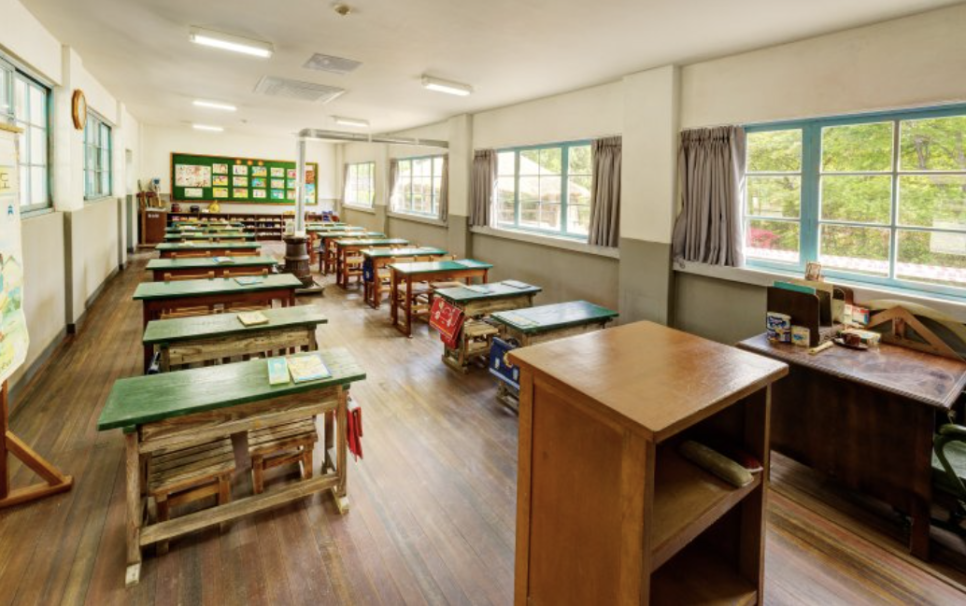
- The format is a 20-minute walk through the outdoor exhibits after dark — the jangseung hill, the Ochondaek house and the Bukchon Elementary School room — followed by a 50-minute lecture in the Traditional Culture Learning Centre.
- Everything is in Korean: the application page, the walk and the lecture, with no interpretation. The same outdoor exhibits are free to walk in museum hours, and on Wednesdays from March to October the museum stays open until 8:00 pm.
The National Folk Museum of Korea is running an evening programme for adults, Evening Ghost Stories: A Chilling Folk Walk. It takes place on five Wednesday evenings between 16 September and 28 October 2026, and the shape of it is a walk through the museum's outdoor exhibition area after dark, followed by a lecture. There is no fee, but each session is capped at 20 people, and once applications opened on 1 September the places went quickly: by 9 September, when we checked, all five sessions were marked full.
Can you still get in? The per-session closing time is the key
The short answer is that the only way in is to wait for a place to free up. But there is one rule worth knowing before you give up. The museum's application page runs a separate application window for each session, and each window closes at 1:00 pm on the day before that session. So even with the capacity full, a cancellation before that time puts a place back on the application page. If there is a session you want, the realistic approach is to check the page a few times up to the morning before, using the closing times below.
Session dates and application closing times (checked 9 September 2026)
- Session 1
- Wednesday 16 September, 6:30 – 8:00 pm · applications close 1:00 pm 15 September · full, 20/20
- Session 2
- Wednesday 30 September, 6:30 – 8:00 pm · applications close 1:00 pm 29 September · full, 20/20
- Session 3
- Wednesday 7 October, 6:30 – 8:00 pm · applications close 1:00 pm 6 October · full, 20/20
- Session 4
- Wednesday 14 October, 6:30 – 8:00 pm · applications close 1:00 pm 13 October · full, 20/20
- Session 5
- Wednesday 28 October, 6:30 – 8:00 pm · applications close 1:00 pm 27 October · full, 20/20
If you already hold a place, the rule runs the other way. Should you be unable to attend, you must telephone the museum at least two days before the lecture date (+82-2-3704-4539 or +82-2-3704-4524). Other people are waiting for these places, and a no-show simply leaves the seat empty.
What happens in the 90 minutes
The name suggests a haunted-house experience, but the programme is closer to a walk stitched to a humanities lecture. The museum describes it as a look at how ghost stories have changed shape from old folk tales to modern popular culture, and what they reveal about attitudes to life and death, the psychology of communities, and the anxieties and desires of modern society. The timetable is as follows.
Running order on the day
- 6:20 pm
- Assemble
- 6:30 – 6:40 pm
- Briefing on the format and safety (Traditional Culture Learning Centre)
- 6:40 – 7:00 pm
- The chilling folk walk — jangseung hill → Ochondaek → Bukchon Elementary School (outdoor exhibition area, 20 minutes)
- 7:00 – 7:50 pm
- Ghost-story salon — lecture and Q&A (Traditional Culture Learning Centre, 50 minutes)
- 7:50 – 8:00 pm
- Wrap-up and survey
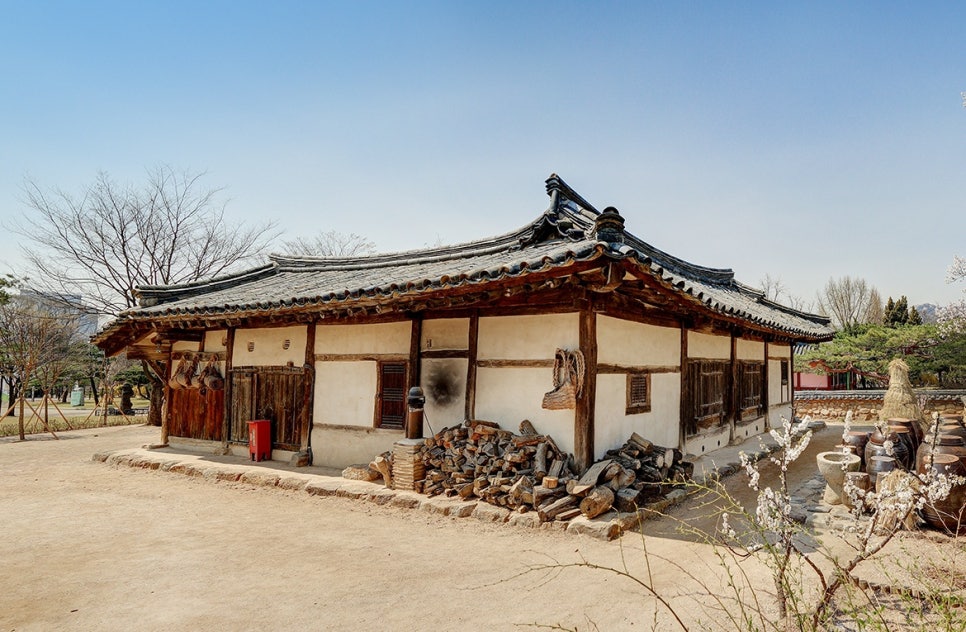
The walk is short, at 20 minutes. It passes the hill of jangseung (carved wooden guardian posts), then Ochondaek, a hanok built in 1848 and moved to the museum in 2010, and then Bukchon Elementary School, a reconstruction of an old classroom. All of it can be seen in daytime; the point of the programme is walking the same route after dark, with only the lighting left on.
Who gives the lecture
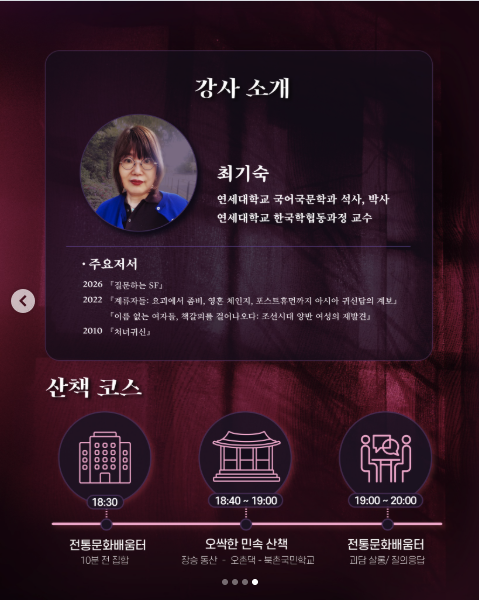
The 50-minute ghost-story salon is led by Choi Key-sook, professor in the Graduate Program in Korean Studies at Yonsei University. She holds a doctorate in Korean literature from Yonsei and works on classical literature as cultural content; the profile the museum published lists as her main books a 2026 volume on questioning science fiction, a 2022 study of the lineage of Asian ghost tales (from monsters to zombies, body-swapping and the post-human) and a 2010 book on the virgin ghost of Korean folklore. A career spent reading ghost stories as literary and cultural-historical sources is exactly what this programme is built on.
Before you go
- No dinner is provided. With a 6:30 pm start, eat beforehand.
- All five sessions have the same content, so there is no reason to apply for more than one — and only one application per person is allowed anyway.
- The walk is outdoors, so bring a layer on a wet or chilly evening.
- You need to be there by 6:20 pm, and it ends at 8:00 pm; plan the rest of the evening around that.
- The museum notes that details may change.
The souvenir claim is unconfirmed
Social media posts say participants receive a souvenir, but there is nothing about it in the programme details on the National Folk Museum's website. Treat it as unconfirmed rather than a promised benefit.
Getting there, and what a non-Korean speaker can expect
The museum stands on the eastern edge of the Gyeongbokgung Palace grounds. Its English directions give Anguk Station (Line 3, Exit 1) or Gwanghwamun Station (Line 5, Exit 2), each about 15 minutes on foot, and the small green bus 11 stops at the museum's front gate; entering from Samcheong-ro means you never pass the palace ticket office, and the museum itself is free. The programme starts after the museum's normal 6:00 pm closing, so it is an after-hours event with its own assembly time of 6:20 pm. There is no English version of the application page and no English booking channel: the form is Korean, and cancellations are made by telephone in Korean. The page does not say a Korean account or mobile number is needed, but nothing about the process is designed for someone who does not read Korean. Once inside, the walk is led and the lecture given in Korean only, with no interpretation, so the 50-minute salon will mean little without the language. What still works is the setting: the outdoor exhibits on the route — the jangseung hill, the hanok Ochondaek and the old classroom — are open to everyone free of charge in museum hours, and on Wednesdays from March to October the museum stays open until 8:00 pm, so you can walk the same ground at dusk without a booking.
Frequently asked questions
- Q. Can I still apply for the Folk Museum's evening ghost-story programme?
- As of 9 September 2026 all five sessions were full at 20 places each. Each session's application window stays open until 1:00 pm on the day before, though, so if someone cancels before then a place reappears on the application page.
- Q. How much does the evening ghost-story programme cost?
- Nothing. It is free, with 20 adult places per session allocated first come first served, and one application per person.
- Q. When does it run?
- On five Wednesdays in 2026 — 16 and 30 September, 7, 14 and 28 October — from 6:30 to 8:00 pm, 90 minutes each time.
- Q. Where does it take place?
- At the National Folk Museum of Korea, 37 Samcheong-ro, Jongno-gu, Seoul. There is a 20-minute walk through the outdoor exhibition area (the jangseung hill, Ochondaek and Bukchon Elementary School) and then a 50-minute lecture in the Traditional Culture Learning Centre.
- Q. Who gives the lecture?
- Choi Key-sook, a professor in Yonsei University's Graduate Program in Korean Studies, gives the lecture and takes questions. She is a scholar of classical literature as cultural content whose books include studies of Asian ghost tales and of the virgin ghost of Korean folklore.
- Q. What if I have a place and cannot go?
- Telephone +82-2-3704-4539 or +82-2-3704-4524 at least two days before the lecture date to cancel, so that the place can go to someone else.
- Q. Is it worth going if I do not read Korean?
- Honestly, no — not this programme. The application page, the walk and the 50-minute lecture are all in Korean with no interpretation, and every session is full in any case. The places on the route are free to visit in museum hours, and on Wednesdays between March and October the museum is open until 8:00 pm, which gives you the same outdoor exhibits at dusk with no booking at all.
Editor's note · Kang Shin-wook
For adult visitors looking for an evening programme at a Seoul museum, and for anyone hoping to pick up a cancelled place in a session that is already full — the per-session deadlines are set out below. The programme itself is Korean-only; the museum's hours, the route in and what it offers in English are in our National Folk Museum visiting guide.
Sources
- Official notice (Korean)
- National Folk Museum of Korea application page — per-session capacity and closing times (Korean)
- National Folk Museum of Korea, education programmes and applications (Korean)
- National Folk Museum of Korea, hours and admission (English)
- National Folk Museum of Korea, directions (English)
Written in our own words from the sources above, never copied from them, and every date and price checked against at least two pages. The originals are in Korean. Spotted a mistake? Ask for a correction.