Exhibition·National Palace Museum of KoreaOn nowFree
Emperor Sunjong's fire-damaged portraits on show — National Palace Museum, free
Summary
From 13 November 2026 the National Palace Museum of Korea, beside Gyeongbokgung, is marking 100 years since the death of Sunjong, the last emperor of the Korean Empire, with a small display in its ground-floor Korean Empire gallery. It brings out two royal portraits — a 1902 portrait of Sunjong as crown prince, shown for the first time, and a 1928 portrait of him as emperor — both of which lost about half their surface in a fire after the Korean War. Entry is free and walk-in, with no booking and no palace ticket, but no closing date has been announced, so check before travelling specially for it.
Article
In short
- From 13 November 2026 the National Palace Museum of Korea is showing two royal portraits of Sunjong and a set of portrait photographs in its ground-floor Korean Empire gallery, marking 100 years since his death.
- One portrait, painted in 1902 for the 40th anniversary of Emperor Gojong's accession, shows Sunjong as crown prince and is on public view for the first time; the other was painted in 1928 by Kim Eun-ho and shows him as emperor.
- Both portraits lost roughly half their surface in a fire after the Korean War and are displayed as they survive.
- A reproduction of Emperor Gojong's grand marshal dress uniform, rebuilt over about a year from photographs, is new in the same gallery.
- Entry is free and walk-in, so there is no Korean-only booking system to get through; no closing date has been announced, and the museum is shut on the last Monday of each month.
Sunjong, the second and last emperor of the Korean Empire, died in 1926. For the centenary the National Palace Museum of Korea, next to Gyeongbokgung Palace, has added a small display inside its permanent exhibition rather than mounting a separate special show: two royal portraits and a group of photographs, set into one side of the ground-floor Korean Empire gallery. That means anyone visiting the museum sees it without a separate ticket. The reason to go is the crown-prince portrait, which has never been shown in public before.
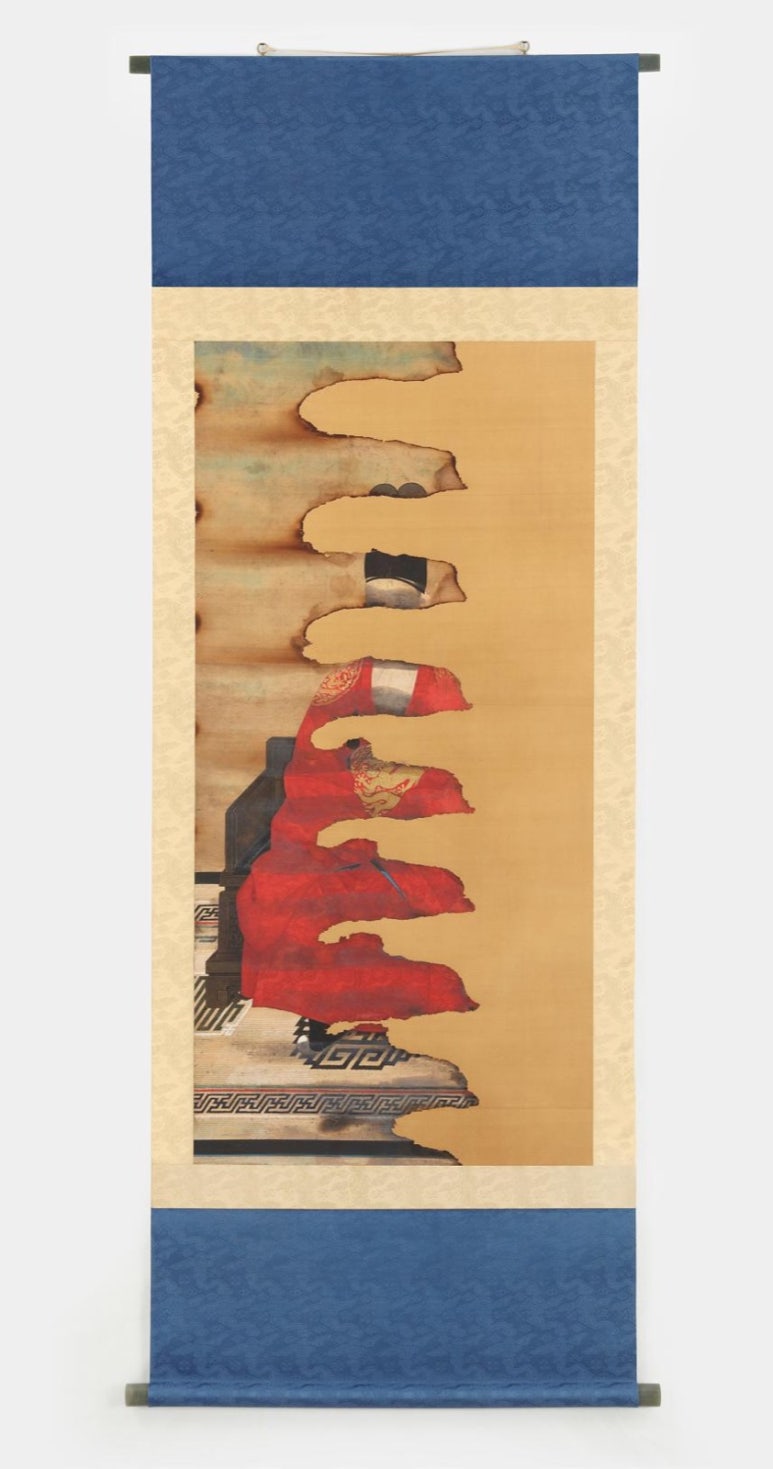
Portrait of Sunjong as crown prince (yejin), 1902, by Jo Seok-jin, An Jung-sik and others, colour on silk — on public view for the first time
Photo: Korea Heritage Service, National Palace Museum of Korea · Original
What is the newly shown crown-prince portrait?
The portrait was made in 1902 to mark the 40th anniversary of Emperor Gojong's accession, as a pair with a portrait of Gojong himself. A portrait of a crown prince had its own name, yejin (睿眞), and this one was enshrined at Punggyeonggung (豐慶宮) in Pyongyang, a jinjeon — a hall built to keep royal portraits and hold rites before them. The photo annex issued by the Korea Heritage Service credits court painters Jo Seok-jin, An Jung-sik and others, working in colour on silk.
The fire took about half of the painting, including the strip that carried its title, so the sitter cannot be read off the picture itself. According to the Korea Heritage Service, the pattern of the woven floor mat, the furniture and the dress are what date it to 1902. In front of the original you see the burnt edge and the surviving red robe together.
How is the 1928 emperor portrait different?
The second portrait shows Sunjong as emperor, in the yellow dragon robe and seated on a yellow chair. It was painted in 1928, two years after his death, and enshrined in the Sinseonwonjeon (新璿源殿) hall at Changdeokgung Palace; the leading portraitist of the day, Kim Eun-ho, painted the face from photographs. This one too lost its right half to fire, but the museum says what remains is enough to confirm the sitter is Sunjong.
The two portraits of Sunjong on display
- Crown-prince portrait (yejin)
- 1902 · Jo Seok-jin, An Jung-sik and others · made for Gojong's 40th accession anniversary, enshrined at Punggyeonggung, Pyongyang · about half lost, including the title · first public showing
- Emperor portrait
- 1928 (after his death) · Kim Eun-ho, face painted from photographs · enshrined at Sinseonwonjeon, Changdeokgung · right half lost
- Both
- Colour on silk · damaged by fire after the Korean War · shown in the ground-floor Korean Empire gallery
Sunjong in photographs, as crown prince and emperor
Alongside the paintings hang portrait photographs of Sunjong as heir and as emperor. In the Korean Empire period, photography was what first put the faces of the emperor and crown prince in front of the public, and such pictures were copied onto postcards and prints as symbols of a modern state. The two images below are from the museum's collection.
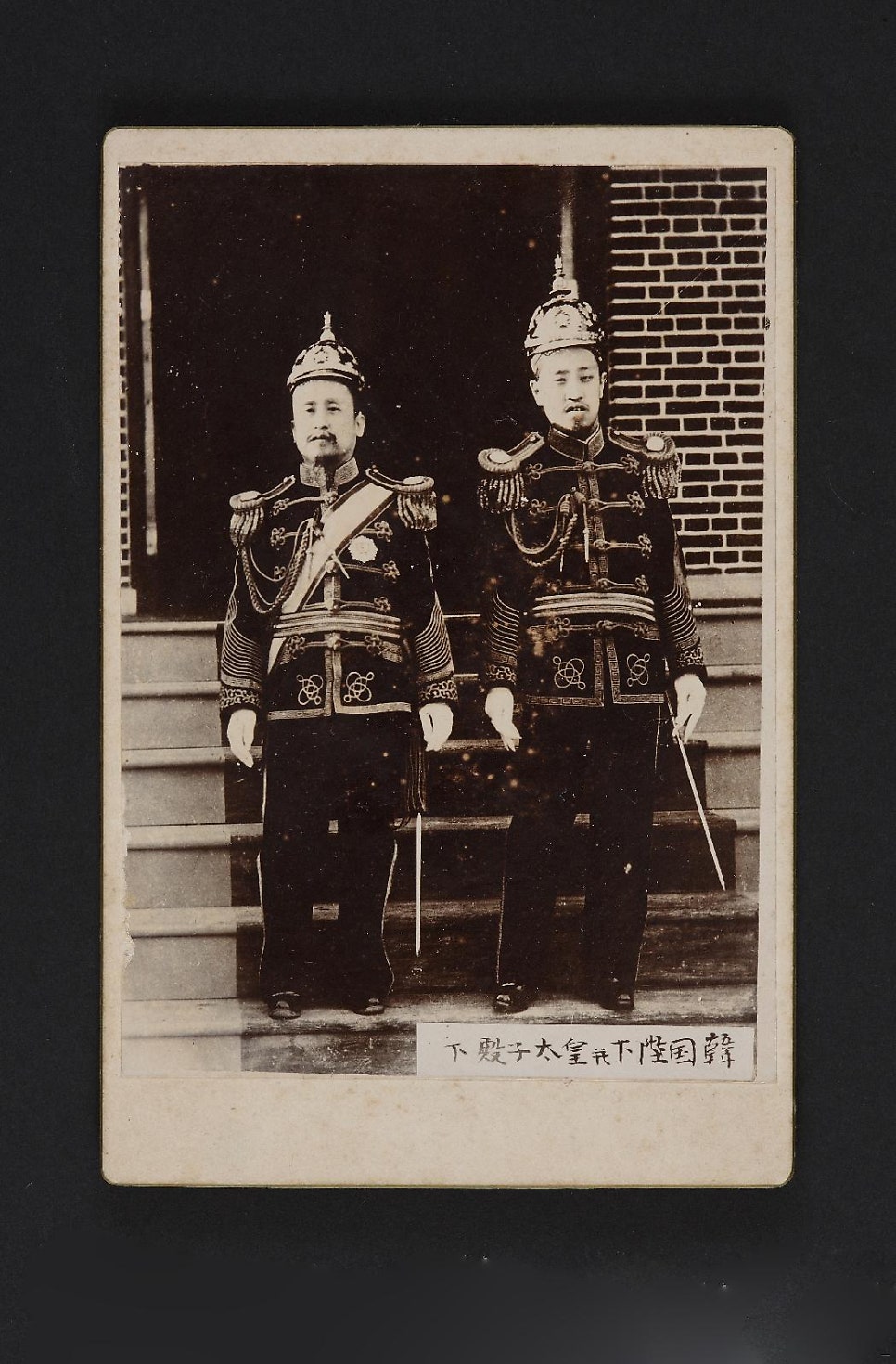
Emperor Gojong and Sunjong as crown prince, printed photograph, Korean Empire period (Gogung 543)
Photo: National Palace Museum of Korea collection / e-museum · KOGL Type 1
Photographic postcard commemorating Emperor Sunjong's enthronement, 1907 (Gogung 545)
Photo: National Palace Museum of Korea collection / e-museum · KOGL Type 1
- Born in 1874, the second son of King Gojong and Empress Myeongseong, and named crown prince the following year.
- Became imperial crown prince when the Korean Empire was proclaimed in 1897.
- Became the second emperor in 1907, when Japan forced Gojong to abdicate over his secret envoys to the Hague peace conference, but with the Japanese Residency-General running domestic affairs he held no real power.
- After the forced annexation of 1910 he was demoted to 'King Yi', lived out his life at Changdeokgung, and died in 1926.
Also new: a reproduction of Gojong's grand marshal uniform
The same gallery has a new piece connected to Emperor Gojong. The Wonsubu, set up in 1899, commanded the Korean Empire's army and navy, and Gojong as its head, the grand marshal, is known in that uniform only from photographs. Working from those photographs, the museum spent about a year rebuilding the full dress uniform, now on show. The photograph below is not of the marshal's uniform; it is another portrait of Gojong in Western-style dress from the museum's collection, included for a sense of the period.
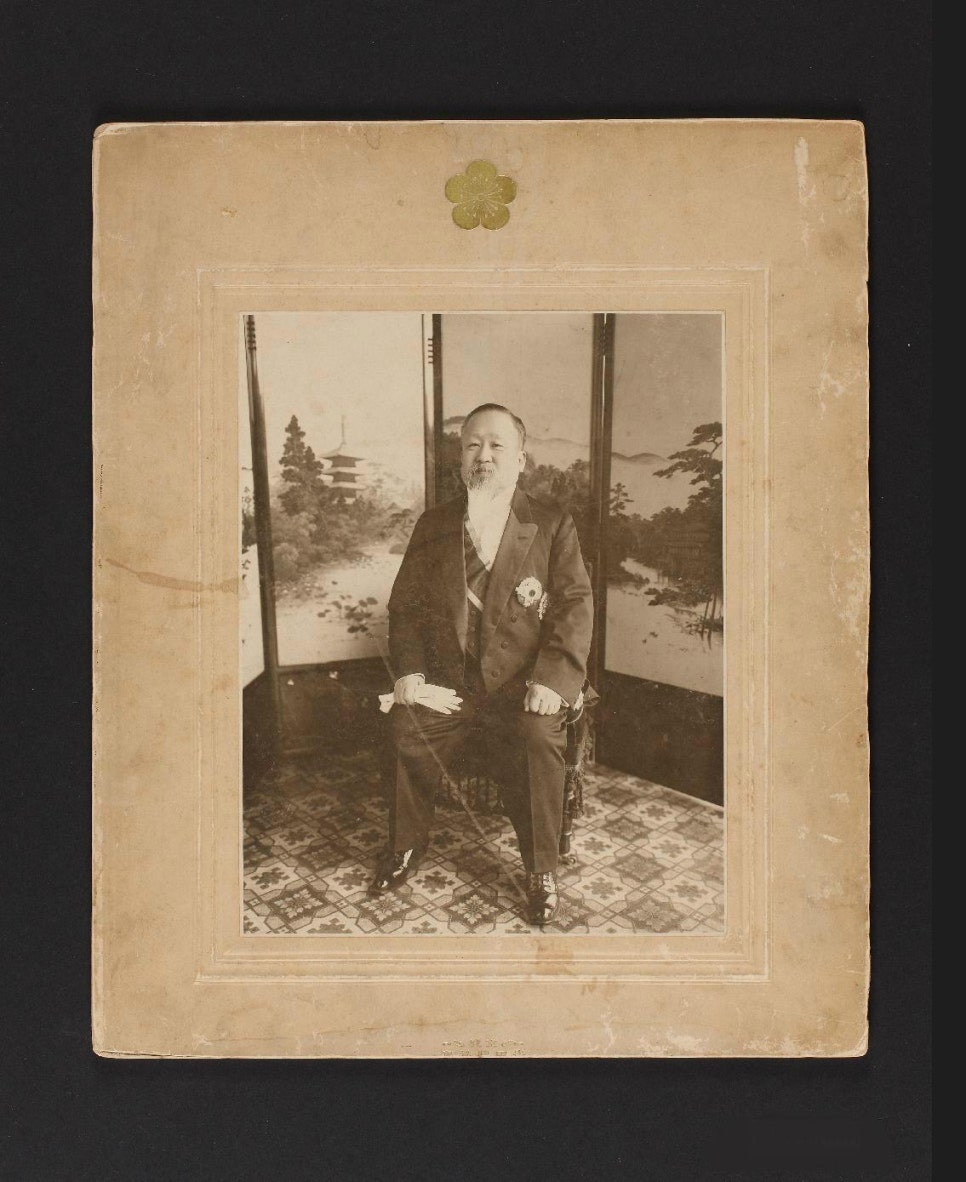
Emperor Gojong in Western-style formal dress (Gogung 366) — a reference image, not a photograph of the reconstructed grand marshal uniform
Photo: National Palace Museum of Korea collection / e-museum · KOGL Type 1
When to go and how to get in
The permanent galleries open Monday to Friday and Sunday from 9:30 am to 5:30 pm (last entry 5:00 pm), and until 9:00 pm on Saturdays and the last Wednesday of each month (last entry 8:30 pm). The museum is closed on the last Monday of each month (the next day if that Monday is a public holiday), on 1 January, and on the days of Seollal and Chuseok. Exit 5 of Gyeongbokgung Station on Line 3 leads straight to it, and no palace ticket is needed.
Closing date not announced
The Korea Heritage Service press release gives only the opening date, 13 November, and no end date. Paintings on silk are usually rotated off display after a period for conservation, so if you are making a special trip, call the museum's exhibitions team (+82-2-3701-7641, Korean) to confirm the portraits are still out. The blog draft of this story gave the closing day as 'the Monday of the last week'; the museum's own visitor page says the last Monday of the month, which is what we use.
Getting there, and what to expect if you do not read Korean
From central Seoul, take Line 3 to Gyeongbokgung Station and follow the signs for Exit 5, which opens onto the museum forecourt; from Incheon Airport allow about 85 minutes via AREX to Seoul Station and Lines 4 and 3. Nothing needs booking: individual visitors walk in, so a foreign phone number or card is never an issue, and the museum is free. The permanent galleries carry labels and panels in Korean and English, but this centenary display was added inside an existing gallery and the press release says nothing about translated captions, so the new labels by the portraits may be in Korean only. The two burnt portraits read well without text — the damage is the story — and this page gives you what the labels would say. Combine it with Gyeongbokgung next door; on Saturdays the museum stays open until 9 pm.
Frequently asked questions
- Q. Where can I see Emperor Sunjong's portraits?
- In the Korean Empire gallery on the ground floor of the National Palace Museum of Korea, 12 Hyoja-ro, Jongno-gu, Seoul. From 13 November 2026 it shows two portraits of Sunjong, portrait photographs and a reproduction of Emperor Gojong's grand marshal uniform.
- Q. How much does it cost, and do I need to book?
- Nothing, and no. The National Palace Museum's permanent galleries are free, individual visitors walk in without booking, and you do not need a Gyeongbokgung ticket.
- Q. How long is the Sunjong portrait display on?
- No closing date has been announced. Paintings on silk may be rotated off display for conservation, so check with the museum's exhibitions team (+82-2-3701-7641, Korean) before a special trip.
- Q. Which portrait is being shown for the first time?
- The 1902 portrait of Sunjong as crown prince, painted for the 40th anniversary of Gojong's accession as a pair with Gojong's portrait. It hung at Punggyeonggung in Pyongyang and lost about half its surface, title included, in a fire after the Korean War.
- Q. When is the National Palace Museum closed?
- On the last Monday of each month (the next day if that Monday is a public holiday), on 1 January, and on the days of Seollal and Chuseok. It stays open until 9 pm on Saturdays and the last Wednesday of each month.
- Q. Is it worth going if I do not read Korean?
- Yes, if you are already at Gyeongbokgung. The permanent galleries have English labels and the entry is free and walk-in. The new captions for this small display may be Korean-only, but the two fire-damaged portraits make their point visually, and this page covers the background. It is a short stop rather than a full exhibition, so do not cross the city for it alone.
Editor's note · Kang Shin-wook
For anyone near Gyeongbokgung looking for something free and indoors, or curious about the last years of Korea's royal family, we checked the Korea Heritage Service press release and its photo annex against the museum's own visitor information. Hours, transport and what else is in the building are on our National Palace Museum visitor guide; other dated exhibitions are in What's on.
Sources
- Official notice (Korean)
- National Palace Museum visitor information (Korean)
- National Palace Museum permanent exhibition (Korean)
- KBS News — Sunjong portraits shown at the National Palace Museum (13 Nov 2026) (Korean)
- MBC News — two portraits of the last emperor shown for his centenary (Korean)
Written in our own words from the sources above, never copied from them, and every date and price checked against at least two pages. The originals are in Korean. Spotted a mistake? Ask for a correction.
Latest from National Palace Museum of Korea
 National Palace Museum of KoreaExhibition13 November 2026In 5 daysFreeKorea's six new 'pre-heritage' objects in photos — Palace Museum, 23 Nov – 6 Dec
 National Palace Museum of KoreaExhibition28 October 2026On nowFreeAhn Jung-geun's 'cannon' calligraphy at the Palace Museum — free to 27 Dec
 National Palace Museum of KoreaExhibition13 October 2026On nowFreeOdaesan's Annals Museum revives King Jeongjo's army in light — free until 13 December
 National Palace Museum of KoreaExhibition29 September 2026On nowA Joseon royal book screen in Paris — Musée Guimet, until 4 January 2027