Exhibition·National Museum of KoreaEnding soonFree
A leaping-carp water dropper at the NMK — free until 22 October
Summary
A white porcelain water dropper shaped like a leaping carp, made in 19th-century Joseon, is on show at the National Museum of Korea from 23 September to 22 October 2026. It sits in the Buncheong Ware and White Porcelain gallery (room 304) on the third floor of the permanent exhibition hall, which is free and needs no ticket or booking. The museum brought it out because this year's grand prize at its costume-play event went to someone who recreated this exact object with body paint. It is 10.6 cm long — smaller than every photograph of it suggests.
Article
In short
- A 19th-century Joseon white porcelain water dropper shaped like a carp (accession no. 건희2082) is on show from Wednesday 23 September to Thursday 22 October 2026, in room 304 on the third floor of the National Museum of Korea's permanent exhibition hall.
- It costs nothing to see and there is nothing to book: the permanent galleries are free and issue no ticket.
- The museum brought it out because the grand prize at this year's costume-play event went to a recreation of this exact object — the idea is to compare the two.
- It is 9.4 cm high and 10.6 cm long, small enough to sit in a palm, which is the part no photograph conveys.
- The display is announced only in Korean and is not listed among the museum's exhibitions, so go knowing the room number rather than expecting signage to lead you there.
There is now a reason to cross Seoul for a single palm-sized piece of porcelain. The National Museum of Korea has put a 19th-century white porcelain water dropper in the shape of a carp (accession no. 건희2082) on display for one month, from 23 September to 22 October 2026, in the Buncheong Ware and White Porcelain gallery on the third floor of its permanent exhibition hall — announced in press release 2026-108. The piece came to the museum in the donation from the collection of the late Lee Kun-hee, and it is out now because this year's grand prize at the museum's costume-play event went to someone who recreated this very object with their own body.
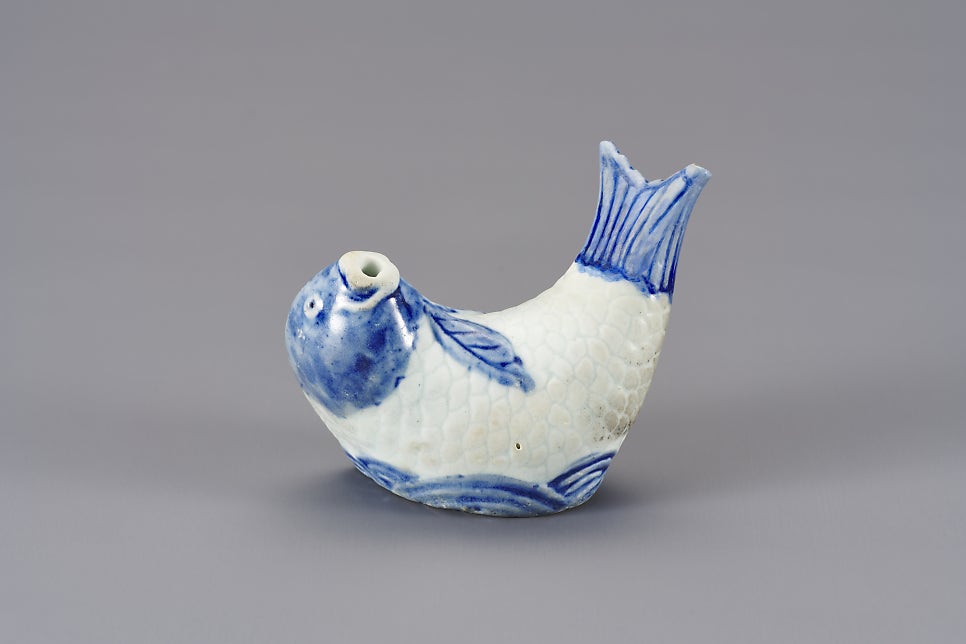
What exactly is this object?
Start with the job it did: it is a desk tool for pouring water onto an inkstone when grinding ink. That a purely practical object was shaped as a fish is where everything interesting about it begins. In the museum's e-Museum catalogue it also appears under the fuller name baekja cheonghwa ihyeong yeonjeok (백자청화이형연적, 白磁靑畫異形硯滴); its accession number (건희2082) marks it as part of the Lee Kun-hee donation.
The size matters. It is 9.4 cm high and 10.6 cm long — in catalogue photographs it reads as substantial, in the case it is a trinket. The head tips downward and the tail fin sweeps up, so a motionless piece of porcelain reads as a fish that has just broken the surface.

Why a carp? The Dragon Gate story
This is not decorative fish. It is the carp of the Dragon Gate — deungyongmun (등용문, 登龍門). The museum explains the piece as a rendering of the old story in which a fish that fights its way up the rapids and over the Dragon Gate finally becomes a dragon. The phrase that story produced still means passing a hard test and vaulting upward, and in Korean it remains in everyday use.
Which makes the choice of subject on a scholar's desk tool obvious enough: it was encouragement, parked beside someone studying for an examination. The modelling is tuned to the same instant. Waves are painted in cobalt blue around the lower part of the vessel, freezing the moment the fish clears the water. In the gallery, look at the waves as well as the fish.
What is a water dropper, exactly?
A water dropper — yeonjeok (연적, 硯滴) — is a small vessel holding the water you tip onto an inkstone while grinding ink, and it is classed among a scholar's desk furniture. Because it pours a little at a time it had to be small, and because it was small its maker had unusual freedom over its shape. That is why Joseon potters lavished such attention on a minor utensil.
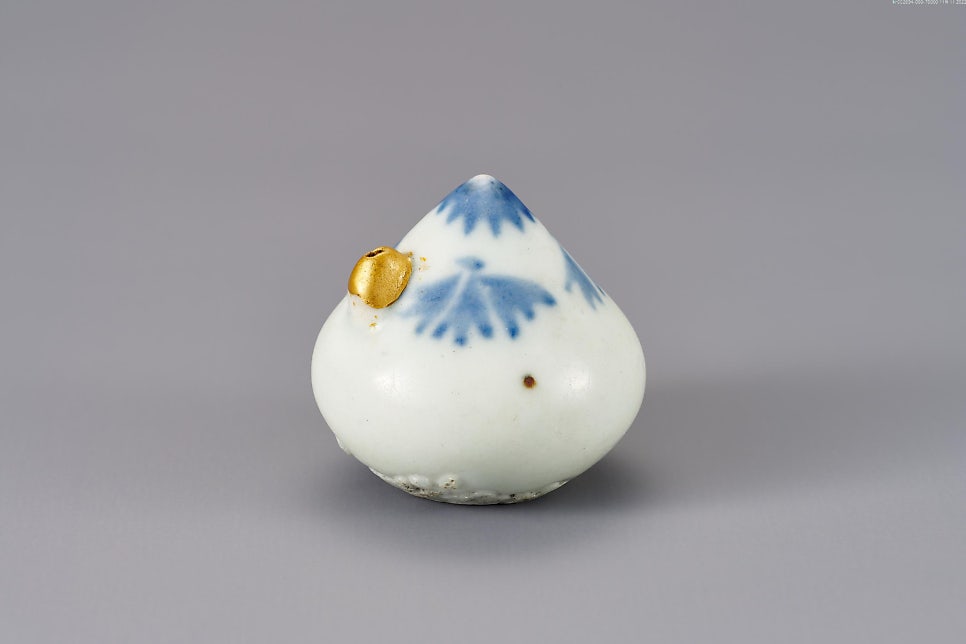
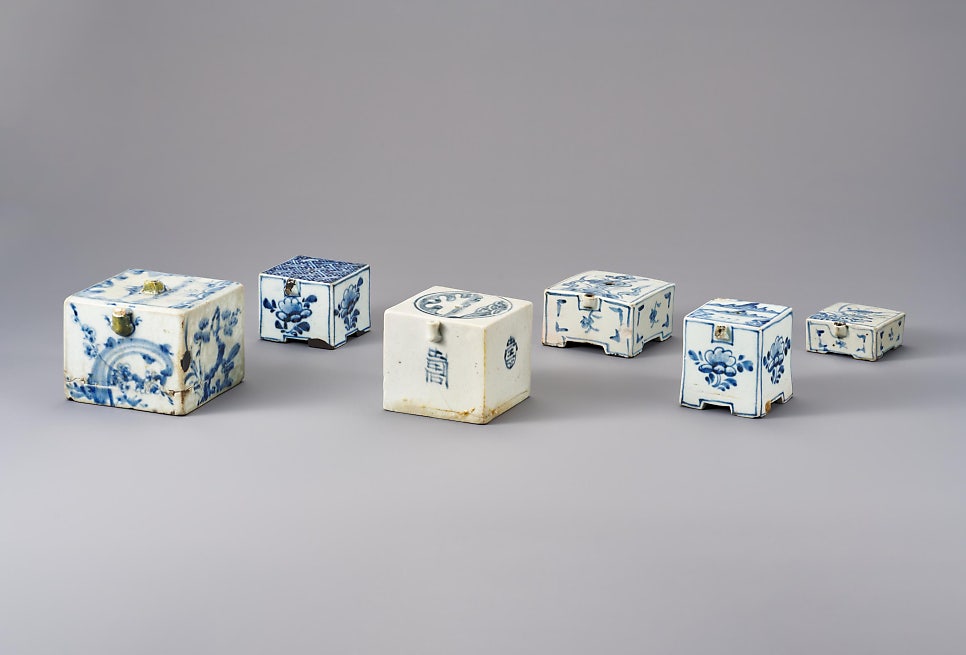
A peach, a plain cube, a carp. Identical in function, nothing like each other in form. The piece on display now sits somewhere on that wide spectrum.
Why show it now? The 2026 costume-play event
The display grew out of Gukjungbak Bunjangnori (국중박 분장놀이), a participatory event in which visitors dress up as objects from the collection and recreate them. The grand prize went to Jeon Eun-seul, whose subject was this water dropper — and the solution was clever. She fixed on the cobalt waves around its base, painted a blue wave along her right arm, and made the leap of the fish with her own body.
The museum pushed the point one step further. The winner was, at the time, looking for work, and the image of a fish forcing its way upstream sat uncomfortably close to that. A carp of the Dragon Gate shaped by a potter two centuries ago, and a job-seeker in 2026: that overlap is more or less the whole of the museum's reason for bringing the object out. Its director said he hoped visitors would enjoy comparing the reinterpretation with the real thing.
The event was not small either. In press release 2026-104 the museum reported that this year it went nationwide for the first time, drawing 275 teams and 643 people. Fifty teams reached regional rounds held at the Chuncheon (5 September), Gongju (6 September), Daegu (12 September) and Jeonju (13 September) national museums, and the 25 who came through those competed in the final on Saturday 19 September in the museum's own open square.
This is not the museum's only carp-shaped water dropper
Search the e-Museum catalogue and several more turn up, made by entirely different techniques and at entirely different sizes — a good illustration of how common the carp motif was on a Joseon desk, and useful context for the piece now on display. To be clear: the four below are not part of this display. They are collection items you can look at online.
Carp-shaped water droppers in the National Museum of Korea collection
- Carp-shaped water dropper (건희2082) — the piece on display
- 9.4 cm high, 10.6 cm long. A single fish modelled in the round, mid-leap, with cobalt waves around the lower body
- Blue-glazed carp-shaped water droppers (신수2849)
- A set of seven small flattened fish that have survived together
- Inlaid carp-shaped water dropper (동원885)
- 2.3 cm high, 18.7 cm across the body. The fish outline flattened into a dish, with a round grinding surface in the centre
- Blue-and-white carp-shaped water dropper (동원820)
- 2.7 cm high, 7.2 cm across the body. Rounded, with scales worked as dense raised bumps
- Blue-and-white carp-shaped water dropper (동원821)
- 2.8 cm high, 8.5 cm in its present length. A shallow boat-like form with scales dotted in cobalt; part of the upper surface is lost
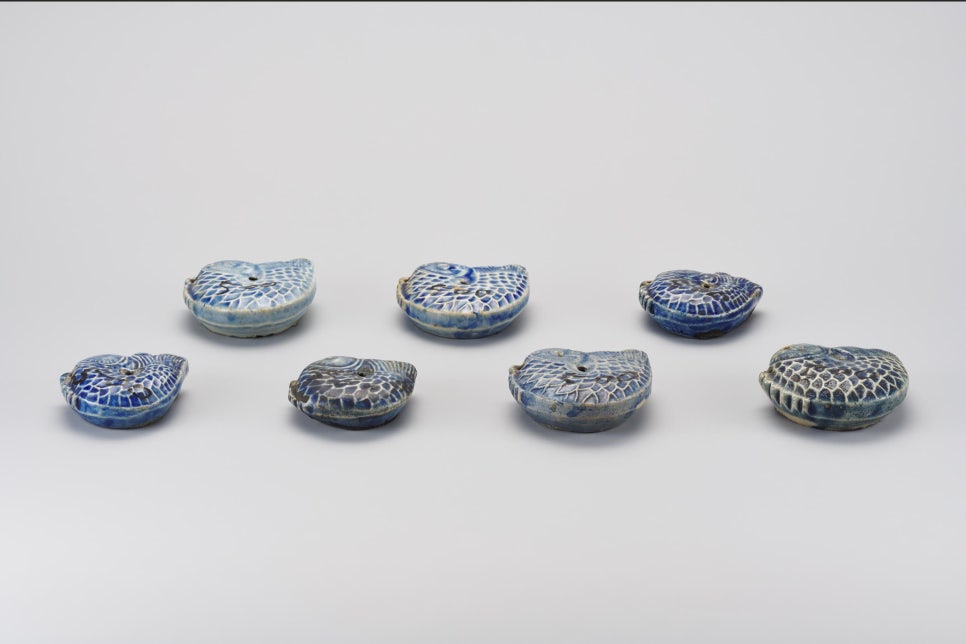
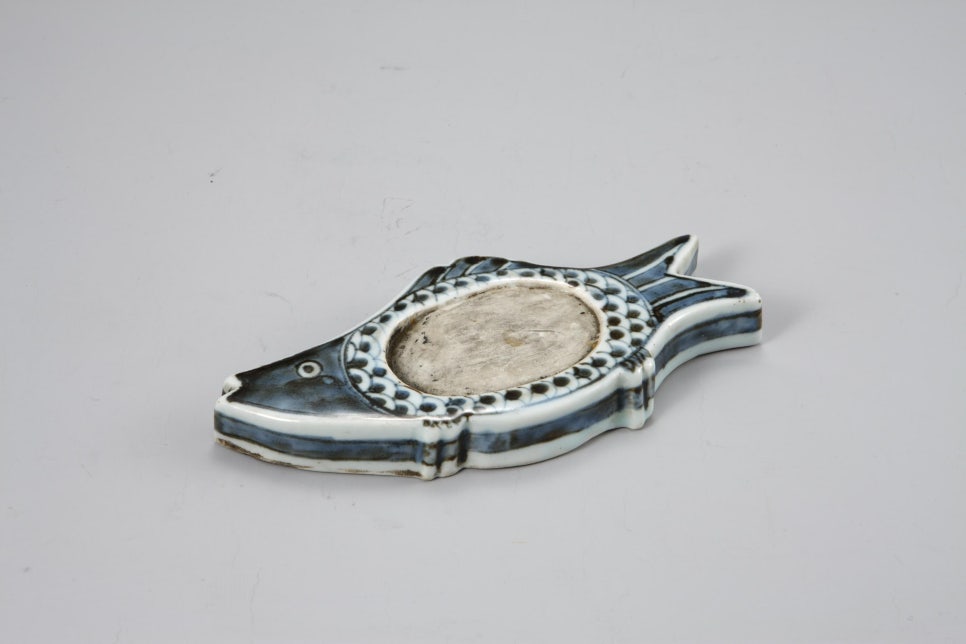
Same description, utterly different objects: one modelled like a sculpture, one flattened like a plate. The two below are blue-and-white pieces that treat the scales in opposite ways.
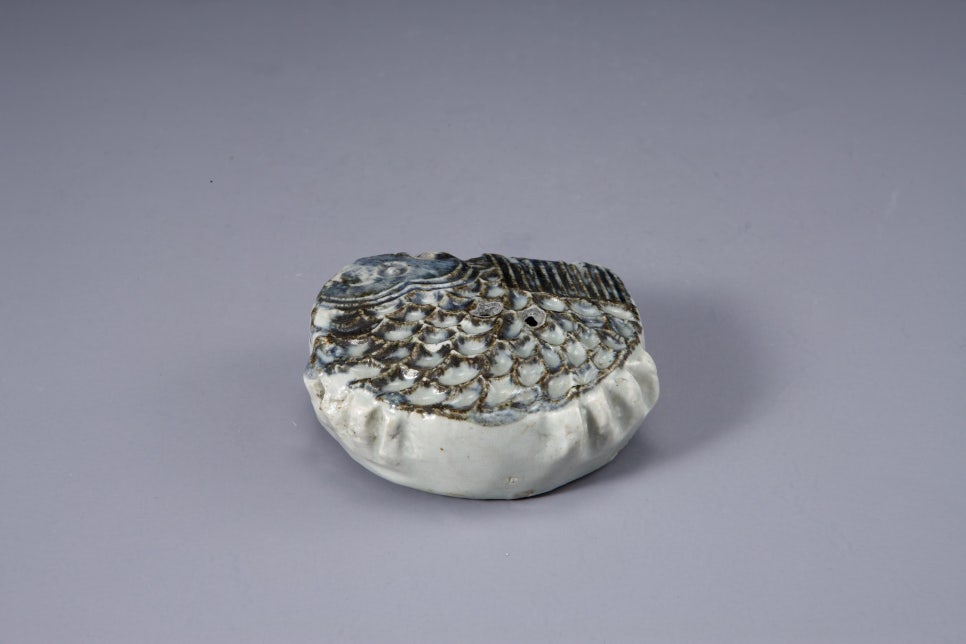
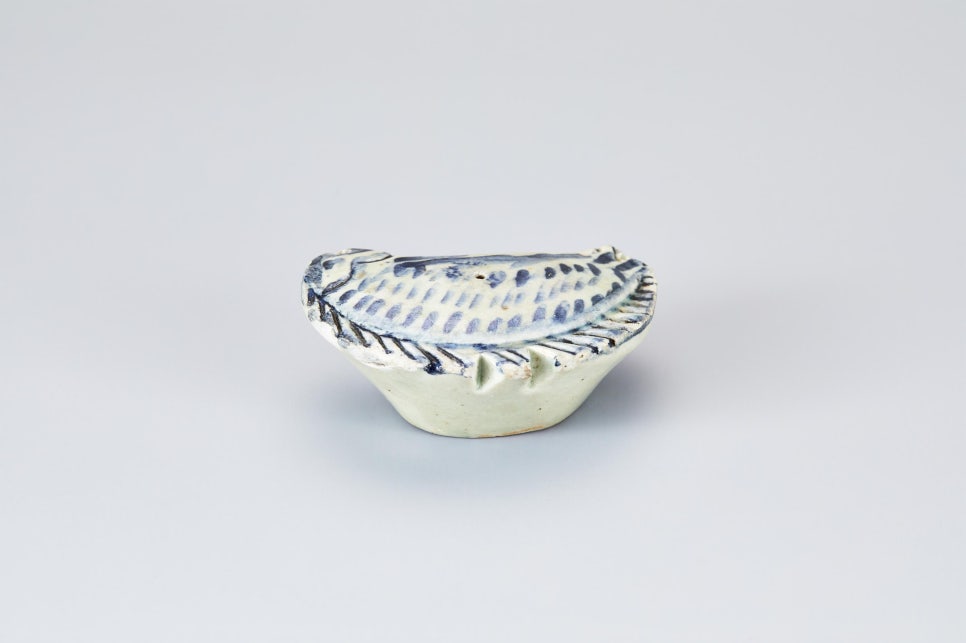
Where to go once you are inside
There is exactly one destination: room 304, the Buncheong Ware and White Porcelain gallery, on the third floor of the permanent exhibition hall. Because the display was announced by press release alone, with no exhibition page of its own, it does not appear in the museum's current-exhibitions list — searching for it there will turn up nothing. The room number is the only thing worth memorising.
There is something to pair it with in the same room. The theme exhibition 'Evergreen Bamboo in Four Seasons, Captured in Ceramics' runs in the Buncheong Ware and White Porcelain gallery from 23 June 2026 until 31 January 2027, so you can carry straight on from the water dropper without moving.
- Opening hours are 09:30–17:30 on Monday, Tuesday, Thursday, Friday and Sunday, and 09:30–21:00 on Wednesday and Saturday. Last admission is half an hour before closing, so an evening visit means a Wednesday or a Saturday.
- Friday 25 September 2026 is the day of Chuseok and the museum is closed. That falls inside the run, so check the date if you are fitting this into the holiday weekend.
- The permanent galleries are free. There is no ticket, no booking and no entry queue.
- In the Sculpture and Craft gallery, the Buddhist Sculpture room (301), the Metal Arts room (302) and the sensory gallery are shut for maintenance from 6 July 2026 to 28 January 2027. The Celadon room (303) and room 304, where this piece is, are open as normal.
- The museum is at 137 Seobinggo-ro, Yongsan-gu, Seoul, about five minutes from Exit 2 of Ichon Station (이촌역) on Line 4 or the Gyeongui–Jungang Line, along a covered walkway.
What we could not confirm
The dates and location rest on a single source, press release 2026-108; the object's dimensions and date were cross-checked against press reporting. Whether the piece carries a National Treasure or Treasure designation is not stated in the published collection record, so we can say neither that it does nor that it does not. Nor has the museum said what happens after 22 October — whether it stays on view or returns to storage. Checking the museum's site or calling before you travel is the safe course.
Getting there, and whether it is worth it without Korean
From Incheon Airport take the AREX all-stop train to Seoul Station, change to Line 4 southbound and get off at Ichon — around 75 to 90 minutes. From Gimpo, Line 9 to Dongjak and then one stop on Line 4, roughly 50 minutes. From Ichon Station, Exit 2 leads into a covered walkway that reaches the museum in about five minutes without going outside. Once inside, walk in past the desk: there is no ticket for the permanent galleries and nothing to reserve, which also means no account, no Korean phone number and no card are involved anywhere. The museum offers free visitor guidebooks as PDFs in seven languages including English, and its English site carries hours and transport. What it does not carry is this display — it was announced only in a Korean press release and appears in no exhibition listing, so plan on a Korean panel beside the case and on finding room 304 yourself from the floor plan.
Frequently asked questions
- Q. How much does it cost to see the carp-shaped water dropper at the National Museum of Korea?
- Nothing. The display sits inside the permanent exhibition hall, which is free for everyone and issues no ticket. There is no booking and no entry queue.
- Q. Where in the National Museum of Korea is the carp-shaped water dropper?
- Room 304, the Buncheong Ware and White Porcelain gallery, on the third floor of the permanent exhibition hall. The display has no exhibition page of its own, so use the floor plan and look for room 304 rather than expecting to find it signposted.
- Q. How long is the carp-shaped water dropper on display?
- From Wednesday 23 September to Thursday 22 October 2026, one month. The museum has not said whether it stays on view afterwards or goes back into storage, so if you want to see it, go inside that window.
- Q. Is the National Museum of Korea open during Chuseok 2026?
- It closes on the day of Chuseok itself, Friday 25 September 2026, and opens as usual on the surrounding days. Hours are 09:30–17:30 on Monday, Tuesday, Thursday, Friday and Sunday, and 09:30–21:00 on Wednesday and Saturday.
- Q. Is it worth going if I do not read Korean?
- Yes, with one adjustment: read the story before you go rather than at the case. The object needs no translation — it is a fish caught mid-leap, and the cobalt waves around its base tell you what is happening. What you would miss is the Dragon Gate legend behind it and the reason the museum brought it out this month, and that is what this page is for. The museum itself is free, easy to reach from Ichon Station and publishes an English guidebook, so the visit costs you nothing but the journey.
Editor's note · Kang Shin-wook
Worth a detour if you are already at the museum, and a reasonable excuse to go back if you have already done the headline galleries. The object is tiny and easy to walk past, so know the room number before you set off. Opening hours, the route from either airport and what is free are set out on National Museum of Korea.
Sources
- Official notice (Korean)
- National Museum of Korea press release 2026-104 on the national finals of the 2026 costume-play event, 16 September 2026 (Korean)
- Buncheong Ware and White Porcelain gallery (room 304), with the current maintenance closures (Korean)
- National Museum of Korea visitor information — hours, closing days, admission (Korean)
- National Museum of Korea English site
- Kyunghyang Shinmun report on the display, 23 September 2026 (Korean)
- Press release on the display (Korean)
Written in our own words from the sources above, never copied from them, and every date and price checked against at least two pages. The originals are in Korean. Spotted a mistake? Ask for a correction.
Latest from National Museum of Korea
 National Museum of KoreaExhibition17 October 2026In 5 daysFreeDunhuang sutras on show for the first time at the National Museum of Korea — free until 24 Jan
 National Museum of KoreaExhibition14 October 2026In 40 daysKunsthaus Zürich masterpieces at the National Museum of Korea — KRW 12,000 early bird until 17 Dec
 National Museum of KoreaNews10 October 2026MU:DS Regional Heritage Collection — 100 museum goods from 13 national museums
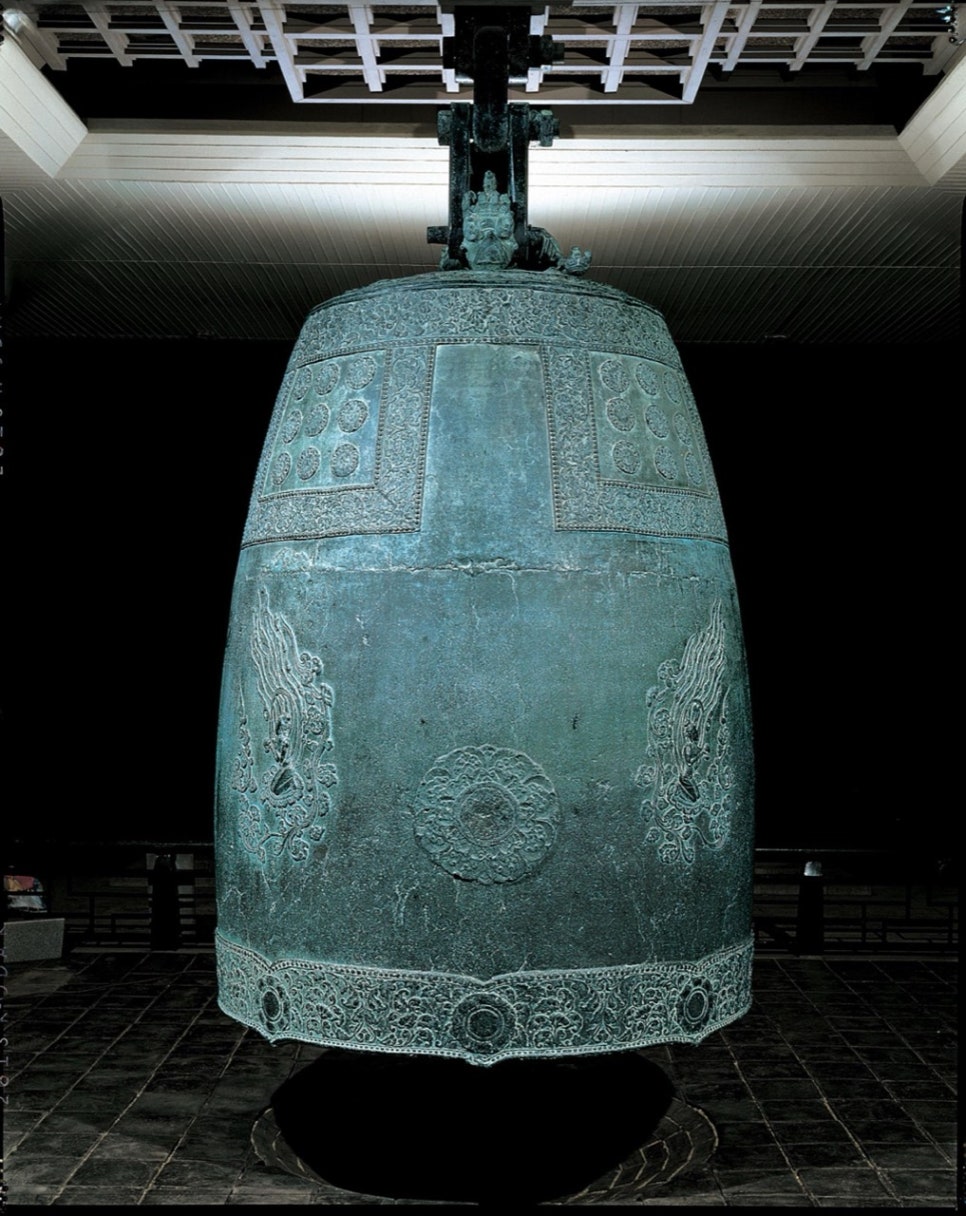 National Museum of KoreaEvent10 October 2026In 13 daysSori: the Seongdeok Bell in concert at the National Museum of Korea — 31 Oct & 1 Nov